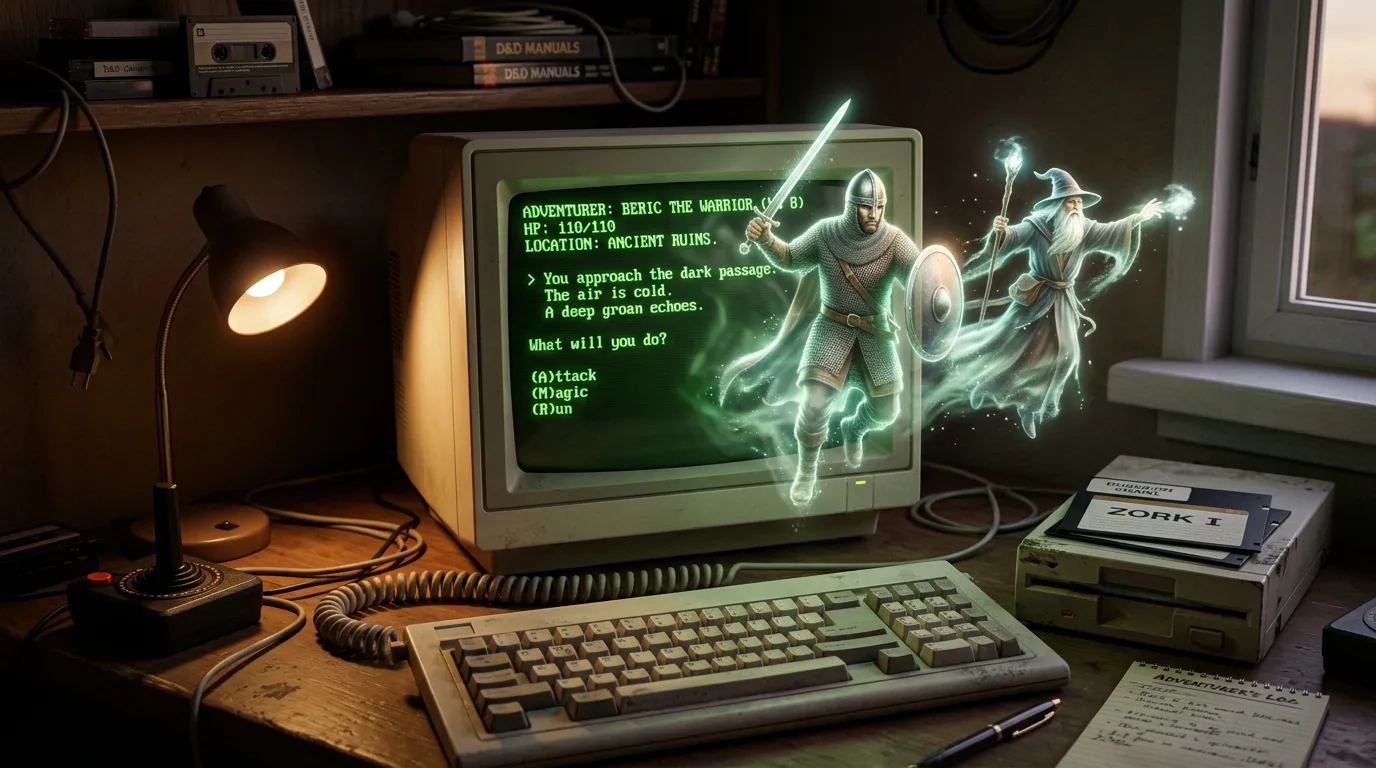
The history of online rpgs is a fascinating journey of technological innovation, social experimentation, and human creativity. Long before millions of players occupied Azeroth or explored the distant galaxies of EVE Online, early computer scientists and passionate gamers in the late 1970s laid the foundations of digital companionship. If you are looking for a quick answer to how this massive genre started, it traces its roots back to the PLATO system mainframe computers and the invention of text-based shared worlds in 1978, which transitioned to graphics in the late 1980s and exploded into the commercial mainstream with Ultima Online in 1997. This article explores that epic transformation step by step.
The History of Online RPGs: From Mainframes to PLATO
To truly understand where our modern virtual worlds came from, we must look back to the mid-1970s. During this era, computers were massive mainframes housed in university basements, accessible only via terminals. It was within these academic environments that the first digital adaptations of tabletop role-playing games began to emerge. The Programmed Logic for Automatic Teaching Operations (PLATO) system, developed at the University of Illinois, became the unexpected cradle of online multiplayer gaming.
PLATO was designed for educational purposes, but its unique infrastructure—featuring plasma screens, touch interfaces, and a networked mainframe—allowed students to write and share programs. In 1975, games like ‘dnd’ (developed by Gary Whisenhunt and Ray Wood) and ‘Moria’ introduced players to persistent dungeon crawling. These were not just single-player experiences; they allowed players to see each other’s progress and interact in shared digital spaces. They translated the complex rules of paper-and-pencil role-playing games into automated, real-time digital systems, proving that computers could handle both the math and the mythology of fantasy gaming.
By 1977, ‘Oubliette’ took this concept even further by introducing group-based adventuring, where players had to cooperate to survive dangerous dungeons. These early mainframe games established the core elements of the genre: character progression, inventory management, stat allocation, and cooperative combat. However, they were still limited to university networks, waiting for a breakthrough that would connect players across the globe.
The MUD Revolution and the Magic of Text-Based Worlds
As computer networking expanded beyond individual university campuses, a new breed of virtual world was born. In 1978, Roy Trubshaw and Richard Bartle, two students at the University of Essex, created a program that would change the gaming landscape forever. They connected a text-based adventure game to the university’s network, allowing multiple users to log in, interact, and explore the same space simultaneously. They named this creation a Multi-User Dungeon (commonly abbreviated as MUD1).
Because these early systems lacked graphical capabilities, they relied entirely on the written word. Players would read descriptive text on their screens—such as ‘You are standing in a dark damp cave. A stone path leads north’—and type commands like ‘go north’ or ‘attack goblin’. This text-only medium required players to use their imagination to visualize the world, creating a deeply immersive and personal experience.
More importantly, MUDs introduced the concept of a persistent virtual world. Unlike traditional games that reset when a session ended, these worlds continued to exist and evolve even when individual players logged off. This persistence fostered the creation of tight-knit social communities, early player guilds, and complex in-game economies. Richard Bartle’s later analysis of these players led to the famous ‘Bartle Taxonomy of Player Types’, which categorized users into Achievers, Explorers, Socializers, and Killers—a framework that still guides modern game design today.
The Golden Age of Commercial Online Networks in the 1980s
During the 1980s, before the public internet as we know it existed, commercial online services like CompuServe, GEnie, and Quantum Link (which later became AOL) began to emerge. Recognizing the immense popularity of MUDs, these services started hosting their own proprietary online games. However, playing them was an expensive hobby.
In 1985, Kelton Flinn and John Taylor released ‘Island of Kesmai’ on CompuServe. It was a highly detailed, text-based RPG that featured rich quest lines and tactical combat. Because CompuServe charged users by the hour to access their network—often costing between $6 and $12 per hour (equivalent to over $30 today when adjusted for inflation)—playing Island of Kesmai was a luxury. Despite the exorbitant costs, dedicated players spent hundreds of dollars a month exploring its digital islands, proving that the demand for shared virtual adventures was incredibly strong.
During this period, developers also began experimenting with visual representations. In 1986, Lucasfilm Games launched ‘Habitat’ on the Commodore 64. While not a traditional fantasy RPG, Habitat was a revolutionary graphical virtual world that pioneered the use of visual ‘avatars’ to represent players. It focused heavily on social interaction, player-driven governance, and virtual economics, offering a vital blueprint for the future of the genre.
How Graphic Horizons Reshaped the History of Massively Multiplayer Online Games
As personal computer hardware advanced and dial-up modems became more common in households, the transition from text to high-fidelity graphics became inevitable. This milestone was a tipping point in the history of massively multiplayer online games, as developers sought to merge the visual appeal of single-player RPGs with the social connectivity of MUDs.
The first true breakthrough came in 1991 with the launch of ‘Neverwinter Nights’ on AOL. Developed by Stormfront Studios, it was the first fully graphical online RPG. Using the gold-box engine from strategic single-player Dungeons & Dragons games, Neverwinter Nights displayed tactical combat grids and colorful character sprites. It was a massive success, operating for several years and hosting thousands of players, serving as a proof of concept that graphical multiplayer worlds were commercially viable.
Following this success, developers pushed the boundaries of technology even further. In 1996, Archetype Interactive released ‘Meridian 59’. It was the first commercial online RPG to feature a first-person, 3D perspective. Meridian 59 introduced players to a fully realized 3D world where they could engage in real-time player-versus-player (PvP) combat and political struggles. It was also one of the first games to transition away from hourly billing, offering a flat monthly subscription fee instead, which dramatically lowered the barrier to entry for casual players.
The Big Bang: Ultima Online and EverQuest
The late 1990s marked the definitive ‘Big Bang’ for the genre. In 1997, legendary game designer Richard Garriott released ‘Ultima Online’. Garriott coined the term ‘Massively Multiplayer Online Role-Playing Game’ (MMORPG) to describe this new scale of gaming. Ultima Online offered an unprecedented level of freedom; it was a vast, open-world ‘sandbox’ where players could buy land, build houses, craft goods, start businesses, or become ruthless outlaws.
However, this freedom came with chaos. The game’s early days were famously wild, characterized by rampant player-killing, hyper-inflation, and the accidental collapse of the game’s simulated ecological systems (players hunted virtual wildlife to extinction within hours of launch). Despite the technical and social hurdles, Ultima Online was a massive commercial triumph, quickly surpassing 100,000 active subscribers.
Just two years later, in 1999, Verant Interactive and Sony Online Entertainment launched ‘EverQuest’. Unlike the isometric, sandbox nature of Ultima Online, EverQuest was a fully 3D, ‘theme park’ style game that focused heavily on structured cooperative play, dungeon raiding, and rigid character classes. It became an absolute cultural phenomenon, earned the nickname ‘EverCrack’ due to its addictive gameplay loop, and laid down the fundamental design tropes—such as tanking, healing, and damage-dealing roles—that still define cooperative online play today.
Key Milestones in the History of Online RPGs
To visualize how these early titles evolved and paved the way for modern gaming, we can look at the key milestones that defined the early eras of the genre:
| Game | Launch Year | Network / Platform | Major Innovation |
|---|---|---|---|
| dnd | 1975 | PLATO Mainframe | First multi-user dungeon crawler with persistent stats |
| MUD1 | 1978 | DEC PDP-10 (ARPANET) | First text-based persistent virtual world |
| Island of Kesmai | 1985 | CompuServe | Rich commercial text RPG with advanced quest systems |
| Neverwinter Nights | 1991 | AOL | First fully graphical cooperative online RPG |
| Meridian 59 | 1996 | PC (Internet) | First 3D online RPG with first-person perspective |
| Ultima Online | 1997 | PC (Internet) | Coined ‘MMORPG’; introduced open-world sandbox and player housing |
| EverQuest | 1999 | PC (Internet) | Fully 3D world; established modern raiding, guilds, and class roles |
The World of Warcraft Era and the Legacy of Early Virtual Worlds
By the early 2000s, the foundation was set. In 2004, Blizzard Entertainment released ‘World of Warcraft’ (WoW). While WoW did not invent the MMORPG, it took the complex, often frustrating mechanics of its predecessors—like severe death penalties and endless grinding—and polished them into an incredibly accessible, user-friendly experience. WoW introduced quest-driven leveling, instanced dungeons to prevent player griefing, and a vibrant art style that ran smoothly on lower-end computers. At its peak, World of Warcraft reached over 12 million active subscribers, cementing the history of online rpgs into the mainstream pop-culture consciousness.
Beyond entertainment, these early virtual worlds left a profound academic and social legacy. In 2001, economist Edward Castronova published a landmark study on the economy of EverQuest’s virtual world, Norrath. He discovered that the nominal hourly wage of an average player in the game was higher than the minimum wage of several developing countries, and that the game’s virtual currency had real-world economic value. This research proved that virtual societies were not mere toys, but complex social and economic systems with tangible real-world impact.
Today, the DNA of these early online games can be found everywhere. Modern social media networks, virtual reality spaces, and battle-pass-driven multiplayer games all owe their existence to the pioneering systems developed in the late 20th century. The early developers and players who navigated those text-based dungeons and primitive 3D landscapes did not just play games; they built the digital communities and virtual architectures that continue to shape our connected world.
Summary
This article explores the fascinating evolution of online role-playing games, starting from the early PLATO mainframe systems of the 1970s and text-based MUDs. It covers the transition to commercial dial-up gaming in the 1980s, the rise of early graphical games, and the massive popularity of late-1990s hits like Ultima Online and EverQuest.
Conclusion
The history of online rpgs is a testament to human creativity and the innate desire for shared social experiences. From the simple, text-based rooms of MUD1 to the sprawling, photorealistic universes of today, these games have grown from niche computer lab projects into a multi-billion-dollar global phenomenon. As technology continues to push the boundaries of virtual and augmented reality, the lessons learned from early online worlds will continue to guide developers in crafting the next generation of digital societies.

Discussion (0)
Join the conversation