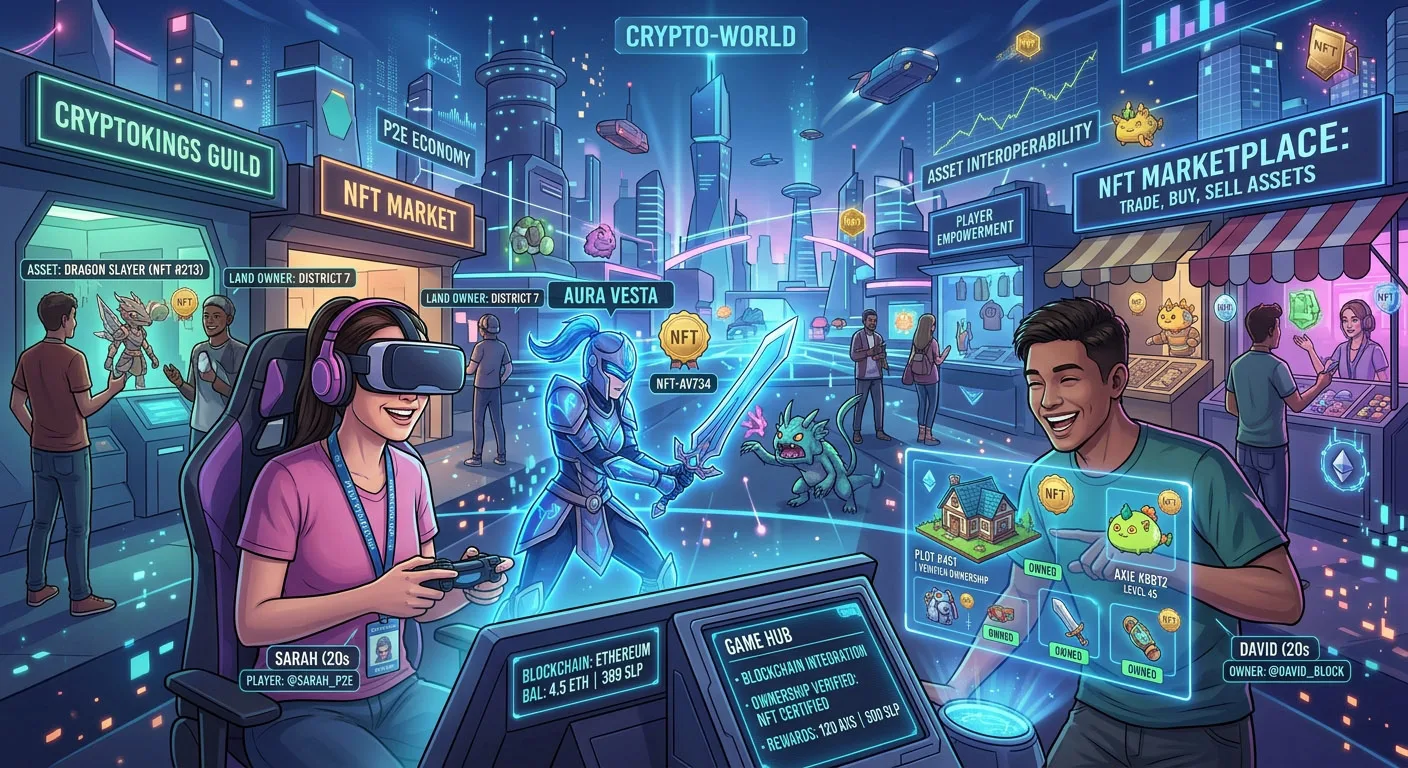
The global video game industry is undergoing a profound structural transformation, migrating from closed entertainment platforms toward open, player-driven financial ecosystems. This evolution fundamentally redefines the economic dynamic between game developers, publishers, and their global player communities.
Introduction: The Shift From Traditional Gaming to Web3 Economies
For decades, traditional video gaming operated exclusively under a centralized Web2 framework. Game studios controlled every facet of the virtual environment, maintaining strict authority over in-game items, currencies, and account balances within closed “walled gardens.” Millions of players collectively invested billions of dollars and countless hours acquiring rare cosmetic skins, powerful weapons, and virtual land. However, under standard end-user license agreements, players never actually owned these digital goods. These assets lacked real-world liquidity, could not be legally traded outside the game ecosystem, and vanished permanently if servers were decommissioned. The introduction of blockchain technology challenged this one-sided economic dynamic by introducing trustless, decentralized ledgers capable of enforcing digital scarcity and verifiable ownership.
The shift toward Web3 architecture catalyzed the Play-to-Earn (P2E) gaming model, fundamentally altering how value flows through virtual worlds. Instead of treating gaming expenses as non-recoverable sunk costs, P2E frameworks align player incentives with network growth by allowing users to extract real monetary value from their active participation. Powered by self-executing code such as Ethereum smart contracts, these Web3 economies facilitate peer-to-peer asset trading, automated yield distribution, and sovereign digital rights without requiring permission from centralized studio executives.
Essential to this technological baseline is the role of the Non-fungible token, which converts intangible digital assets into unique, provably scarce cryptographic property. By turning characters, gear, and virtual real estate into tradeable tokens, Web3 gaming establishes a sustainable bridge between interactive entertainment and broader decentralized financial markets. This shift represents more than a technological upgrade; it marks a strategic transition toward equitable digital labor markets where user contributions are directly monetized, paving the way for unprecedented economic interoperability across next-generation virtual gaming environments.
Understanding the Mechanics of NFTs in Video Games
In traditional video game ecosystems, digital assets such as character skins, specialized weaponry, and virtual real estate remain under the centralized control of game publishers. If a publisher shuts down its servers or suspends an account, the player forfeits access to all acquired items. The Play-to-Earn (P2E) model disrupts this centralized structure by converting in-game items into sovereign digital property. At the core of this technical evolution is the Non-fungible token, a cryptographic asset that represents verifiable ownership of a specific, non-interchangeable digital item on a decentralized network.
The underlying infrastructure supporting these tokenized assets relies fundamentally on blockchain technology. By recording token transactions across a distributed ledger, games ensure that item scarcity, origin, and ownership histories are immutable and publicly auditable. Developers establish the operational rules of these items through code, frequently leveraging Ethereum smart contracts to execute self-enforcing transactions. These automated protocols manage essential functions, such as item minting, dynamic attribute updates, and creator royalty distribution upon secondary sales, eliminating the need for intermediaries.
Because NFTs exist independently of a game’s central server, they unlock several powerful mechanics that drive the P2E economy:
- Sovereign Digital Ownership: Players store their virtual assets in personal Web3 wallets, granting them total control outside the software developer’s ecosystem.
- Secondary Market Liquidity: Gamers can sell, purchase, or lend their items on open decentralized marketplaces for cryptocurrency or fiat currency.
- Cross-Platform Interoperability: Developers can design assets that function across multiple games or virtual metaverses, increasing their broader utility.
Additionally, modern P2E mechanics incorporate dynamic metadata, allowing an asset’s on-chain properties to change as players upgrade items or achieve milestones. Consequently, an NFT’s market value directly reflects both its cryptographic rarity and the time, skill, and effort invested by the gamer.
True Digital Ownership: Empowering the Player Base
In traditional video games, players spend countless hours and substantial financial resources acquiring rare in-game assets, yet they possess zero technical ownership over them. Centralized game publishers retain complete control, meaning player accounts can be suspended, item attributes altered, or servers permanently shut down, instantly dissolving years of accumulated value. The Play-to-Earn (P2E) model fundamentally disrupts this one-sided dynamic by establishing verifiable, sovereign digital ownership for the global player base.
At the heart of this structural shift is the Non-fungible token (NFT). Unlike standard database entries, an NFT functions as a cryptographically secure representation of a unique asset. By utilizing decentralized blockchain technology, developers anchor virtual items—such as specialized weaponry, character skins, cosmetic gear, and digital land parcels—to a transparent, immutable public ledger. Consequently, item provenance, rarity, and ownership history are permanently documented outside the internal infrastructure of the game studio itself.
The integration of programmable logic via Ethereum smart contracts further empowers players by enabling permissionless, trustless transactions across open global markets. These automated contracts govern secondary market trading, royalty distributions, and asset utility without requiring publisher approval. By granting gamers total financial authority over their inventories, true digital ownership delivers significant structural advantages:
- Asset Sovereignty: Gamers retain full control over their digital inventory, ensuring items exist independently of any single game’s lifecycle.
- Open Monetization: Players can freely sell, trade, or rent their assets on third-party exchanges for liquid digital currencies.
- Economic Alignment: Transfers power from centralized studios directly to participants, elevating players from passive consumers into active economic stakeholders.
Economic Models: Monetization, Stalking, and Secondary Markets
The economic engine of the Play-to-Earn (P2E) framework relies heavily on turning in-game achievements and player time investments into tangible, real-world financial value. At the core of this monetary transformation is the Non-fungible token (NFT), which standardizes digital scarcity, provable authenticity, and absolute asset ownership across decentralized networks. Players monetize their gameplay by acquiring rare in-game assets—such as virtual real estate, specialized weaponry, cosmetic skins, or collectible characters—and exchanging them on open marketplaces. Unlike traditional web2 gaming ecosystems, where user expenditures represent pure sunk costs with zero financial liquidity, P2E architectures empower players to extract direct economic utility from their digital endeavors.
To encourage sustainability and limit speculative asset dumping onto open markets, modern web3 gaming protocols increasingly incorporate yield-bearing mechanics like asset staking. Staking enables players to temporarily commit their tokenized assets to a protocol vault in exchange for ongoing yield rewards, governance power, or utility multipliers. Powered by immutable blockchain technology, asset staking creates a mutually beneficial dynamic: it curtails the active circulating supply of game items to help stabilize floor prices, while simultaneously providing active token holders with passive income streams without requiring them to relinquish permanent asset ownership.
Secondary markets form the vital liquidity layer of P2E economies, facilitating peer-to-peer trading across both decentralized marketplaces and dedicated in-game storefronts. These secondary trading environments rely on Ethereum smart contracts to automatically execute escrow-less transfers and enforce perpetual royalty mechanisms. Each time an asset trades hands on a secondary platform, a pre-configured percentage of the sales price automatically routes back to game developers and creators. This automated perpetual income stream aligns developer interests with long-term ecosystem health, creating a self-reinforcing economic loop that continuously rewards active players, asset traders, and original game developers alike.
Challenges: Volatility, Sustainability, and Player Retention
While the integration of Non-fungible token assets has introduced true digital ownership to gaming, the Play-to-Earn (P2E) model faces formidable hurdles that threaten its long-term market viability. Chief among these concerns is extreme economic volatility. Unlike traditional in-game cosmetics, P2E assets are directly tied to speculative cryptocurrency markets. Fluctuations in broader asset valuation can instantly erode a player’s invested time, energy, and capital. When secondary market values plummet, the financial incentives driving player participation collapse, leading to rapid capital flight and game ecosystem decay.
Long-term economic sustainability represents another critical structural bottleneck. Many early P2E frameworks functioned similarly to unsustainable economic pyramids, relying on a continuous influx of new players purchasing initial access assets to subsidize the yields of established users. Without robust, dynamic tokenomics that balance asset minting with meaningful burn sinks, hyperinflation inevitably devalues in-game rewards. Furthermore, integrating blockchain technology often introduces volatile transaction fees and network congestion during peak activity, degrading user experience and limiting mainstream accessibility.
Player retention highlights a fundamental conflict between financial speculation and core gaming entertainment. When games prioritize earning mechanics over fun, engaging design, they attract short-term financial speculators rather than dedicated gamers. These mercenary players immediately abandon the ecosystem as soon as profit yields narrow. Additionally, relying on automated protocols like Ethereum smart contracts to execute reward distributions and asset transfers exposes ecosystems to code vulnerabilities and exploits. If a smart contract breach compromises rare digital items, player trust dissolves permanently.
Ultimately, for NFT-driven P2E models to achieve mainstream longevity, game developers must strike a delicate equilibrium between economic incentives, robust security, and deeply compelling gameplay. Overcoming these volatility, sustainability, and retention challenges requires shifting away from hyper-financialized speculation toward player-first, utility-focused virtual economies that retain users through genuine entertainment value rather than monetary return alone.
Conclusion: The Long-Term Trajectory of NFT-Powered Games
The integration of decentralized asset ownership through play-to-earn (P2E) models represents a profound structural evolution within the global interactive entertainment landscape. As traditional gaming transitions from closed, publisher-controlled environments toward open economic frameworks, the Non-fungible token stands as a core building block of this transformation. By providing immutable proof of digital scarcity, verifiable provenance, and true player ownership over in-game items, NFTs have successfully shifted virtual economies from simple consumer spend sinks into dynamic, value-generating ecosystems.
Looking ahead, the long-term trajectory of Web3 gaming hinges on overcoming early structural vulnerabilities. First-generation P2E models frequently favored hyper-financialization and rapid token speculation over deep, engaging gameplay, resulting in unsustainable economic hyperinflation and rapid player drop-offs. The industry is now pivoting toward a more balanced “play-and-earn” paradigm—one where high-quality game design, captivating narratives, and fun take center stage alongside secondary economic benefits. Underpinning this next iteration is advanced blockchain technology, offering high-throughput layer-2 scaling, negligible transaction costs, and seamless cross-chain interoperability necessary to support traditional gaming scales.
Furthermore, the continuous evolution and deployment of Ethereum smart contracts ensures that sophisticated economic mechanics—such as peer-to-peer asset rentals, automated perpetual royalties, and community-governed Decentralized Autonomous Organizations (DAOs)—can execute autonomously, transparently, and securely without centralized administrative overhead. This trustless infrastructure creates an unprecedented alignment of long-term economic incentives between studio developers, original creators, and active gaming communities.
In conclusion, while regulatory clarity, friction-free onboarding user experiences, and security protocols must continue to mature, the long-term trajectory for NFT-powered games is remarkably bright. As major legacy gaming studios begin selectively integrating Web3 components, digital assets will transcend individual game boundaries. Ultimately, NFTs will serve as the core architecture for an interconnected gaming metaverse, forever elevating the relationship between player time, competitive skill, and real-world economic value.
Frequently Asked Questions
What is the main role of NFTs in Play-to-Earn (P2E) games?
NFTs serve as digital proof of ownership for unique in-game assets like characters, weapons, and virtual land. They ensure that players truly own their items rather than just renting them from game developers. Consequently, players gain the freedom to trade, sell, or hold these assets outside of the game standard ecosystem.
How do NFTs enable real-world financial rewards for players?
Players earn NFT assets by completing quests, winning battles, or achieving high ranks within the game. Because these assets are minted on a blockchain, players can export them to secondary marketplaces to sell for cryptocurrency or fiat money. This creates a direct link between in-game time investment and actual monetary value.
How do NFTs protect the scarcity and value of in-game items?
NFTs utilize blockchain smart contracts to enforce verifiable scarcity and clear provenance for digital items. Unlike traditional games where developers can print unlimited items, NFT supply limits are transparent and unalterable. This provable rarity helps maintain an item’s market value based on community demand and in-game utility.
What is the concept of interoperability regarding gaming NFTs?
Interoperability refers to the potential for a single NFT asset to be used across multiple different games or metaverses. Because NFTs reside on decentralized blockchains rather than isolated game servers, independent developers can integrate existing NFTs into their own projects. This extends the life cycle and utility of a player’s digital assets beyond a single game.
What are NFT scholarships in the Play-to-Earn model?
NFT scholarships are rental agreements where investors lend their gaming NFTs to players who cannot afford the initial buy-in costs. The active player uses these borrowed NFTs to play the game and earn in-game tokens. The resulting profits are then automatically split between the asset owner and the player according to a predefined agreement.
What risks should players consider regarding NFTs in P2E games?
The primary risk is market volatility, as the financial value of gaming NFTs can fluctuate wildly based on player retention and market trends. Furthermore, if a game loses its user base or developers discontinue support, the underlying NFTs may lose significantly in utility and resale value. Players also need to be cautious of smart contract exploits and digital wallet security risks.
Discussion (0)
Join the conversation