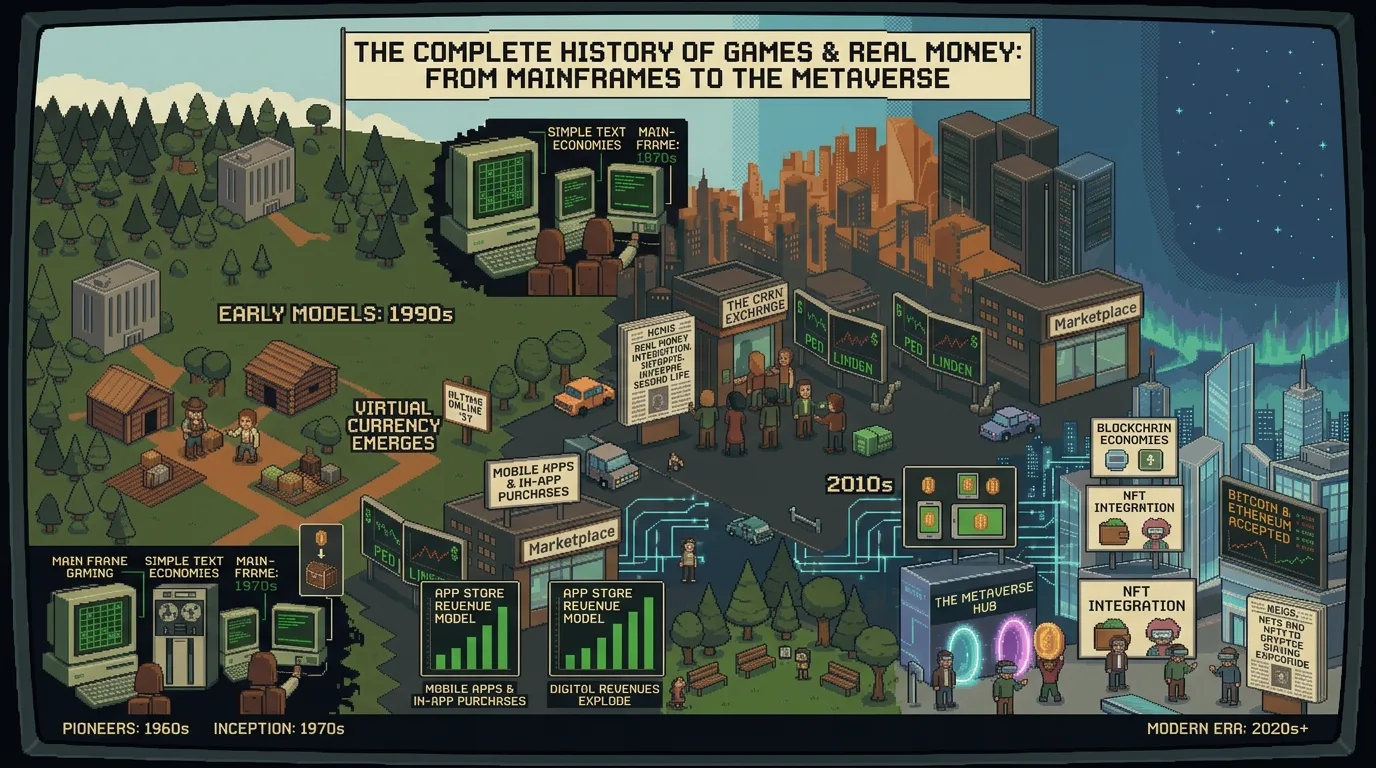
The evolution of interactive entertainment reached a pivotal milestone when developers began bridging the gap between digital achievements and tangible financial assets, giving rise to the first true real money games. This socio-technical paradigm shift transformed casual hobbies into complex financial ecosystems, fundamentally altering how players perceived in-game labor, digital scarcity, and ownership.
Introduction: The Genesis of Virtual Value
In the early era of persistent online worlds, virtual assets held value only within isolated server databases. However, as player bases expanded, emergent gray markets began to form around pioneering titles like Ultima Online, where users traded rare artifacts, resources, and digital real estate on external auction websites. This organic, player-driven demand proved that digital items could command real-world fiat currency, laying the conceptual and economic groundwork for highly sophisticated, developer-sanctioned virtual economies that mirrored real-world financial systems.
The Architectural Shift to Real Money Games
This transition from informal, high-risk barter systems to structured monetary integration culminated in platforms like Second Life, which pioneered a fully convertible currency pegged directly to the US dollar. By designing secure, bidirectional transactional pathways, developers realized they could mitigate fraud, drive unprecedented user retention, and capture transactional micro-fees, transforming interactive software into legitimate engines of economic activity. This architectural evolution laid the foundation for modern play-to-earn structures and real-money gaming ecosystems today.
The Dawn of Real Money Games: Text MUDs and Early Trading
Long before modern digital marketplaces, the intersection of virtual accomplishments and tangible currency began in text-based Multi-User Dungeons (MUDs). During the late 1980s and early 1990s, these terminal-based, multiplayer environments fostered highly dedicated player bases. As rare equipment, high-level characters, and scarce in-game currency became status symbols, players bypassed software limitations to trade virtual assets for fiat currency. These transactions, facilitated via Usenet newsgroups, IRC channels, and early web forums, established the foundational architecture of primitive virtual economies.
The Genesis of Real Money Games in Text-Based Worlds
These early interactions fundamentally transformed how developers and players viewed digital ownership. What started as informal, gray-market transactions in text MUDs quickly scaled with the advent of graphical MMORPGs. The release of Ultima Online in 1997 marked a critical inflection point. Suddenly, virtual real estate, such as digital castles and keeps, was being auctioned on eBay for thousands of dollars. This solidified the concept of real money games, where players realized that cognitive labor and time investment in a synthetic world could yield real-world financial returns.
This paradigm shift proved that virtual goods possessed intrinsic economic value. It bridged the gap between leisure and labor, setting a technical and legal precedent that would later be formalized by platforms like Second Life, which integrated open-market economic systems directly into their codebase, complete with real-world currency convertibility.
Ultima Online and the Rise of Unofficial RMT Markets
The Genesis of Real Money Games through Gray Markets
Released in 1997, Ultima Online inadvertently pioneered the concept of player-driven, persistent virtual wealth. While Origin Systems designed the game’s currency, reagents, and housing plots to exist solely within the boundaries of Britannia, players quickly assigned real-world value to these scarce digital assets. This economic shift birthed the earliest unofficial gray markets for real money games. Online auction sites like eBay suddenly became de facto trading floors where high-end castles, rare dyes, and millions of gold pieces were exchanged for fiat currency, bypassing the developers’ intended gameplay loops.
These emergent real-money trading (RMT) ecosystems demonstrated that complex virtual economies could not be isolated from real-world macroeconomic forces. The persistence of server states, combined with absolute digital scarcity, created intrinsic utility functions that players were willing to finance with actual capital. This friction between developer intent and player behavior highlighted a massive, untapped demand. Ultimately, the unauthorized secondary markets of Britannia laid the foundational economic and behavioral frameworks for subsequent real money games and officially sanctioned virtual cash shops, such as those later popularized by platforms like Second Life.
Project Entropia: The First Official Real Money Games Economy
Launched in 2003 by Swedish developer MindArk, Project Entropia (later renamed Entropia Universe) represented a massive paradigm shift in MMO design. While predecessor titles like Ultima Online suffered from unauthorized, volatile grey-market trading, MindArk pioneered a fully integrated, legally compliant cash-to-game currency pipeline.
The Architectural Blueprint for Real Money Games
The core of this technical innovation was the Project Entropia Dollar (PED), which was pegged directly to the US Dollar at a fixed 10:1 exchange rate. This hard peg allowed players to deposit real capital to acquire in-game assets and, critically, withdraw their accumulated PED back into real-world bank accounts. This mechanism redefined virtual economies by transforming digital items—such as virtual land deeds, mining rights, and high-tier weaponry—into legitimate financial assets with real-world value.
While other platforms like Second Life would later popularize user-generated commerce, MindArk established the foundational infrastructure for modern real money games. By tying every in-game action—such as weapon degradation, ammo consumption, and resource harvesting—to a direct fiat cost, MindArk engineered a highly sophisticated sink-and-source economic model. This system proved that virtual worlds could support complex, self-regulating financial ecosystems while maintaining long-term monetary stability and mitigating hyperinflation risks.
Second Life: Bridging the Gap Between Virtual and Real Currency
While early MMORPGs like Ultima Online saw emergent grey markets for in-game gold, Linden Lab’s Second Life revolutionized the industry by formalizing the connection between virtual assets and fiat currency. Launched in 2003, this platform bypassed traditional game loops to establish one of the most sophisticated, user-driven virtual economies in digital history.
The Evolution of Real Money Games: Linden Dollars and Liquidity
At the core of this ecosystem was the Linden Dollar (L$), a digital currency backed by a floating exchange rate on the LindeX—the platform’s official, proprietary currency exchange. Unlike contemporary titles where real-world trading was strictly prohibited, this platform actively facilitated the monetization of user-generated content, intellectual property, and virtual real estate. This structural pivot redefined the architecture of real money games by allowing players to legally convert virtual earnings back into USD, creating genuine career paths for digital creators.
From a technical perspective, this integration required robust transactional security, double-entry bookkeeping ledgers, and compliance with evolving financial regulations regarding virtual asset transmission. By implementing a developer-friendly API for financial transactions, the platform demonstrated how virtual environments could operate as legitimate economic micro-states. This pioneering approach laid the foundational infrastructure for modern play-to-earn models and the broader classification of interactive monetized gaming platforms today.
The Technical and Legal Challenges of Early Real Money Integration
Early developers attempting to bridge virtual and physical currencies faced unprecedented technical hurdles. Legacy database architectures were not designed to handle the strict ACID (Atomicity, Consistency, Isolation, Durability) compliance required for secure financial transactions. In titles like Ultima Online, item duplication exploits and packet sniffing threatened to destabilize early virtual markets. Without robust cryptographic verification and secure APIs connecting game servers to payment gateways, securing these proto-real money games against fraud was an ongoing battle.
Regulatory Hurdles in Early Real Money Games
On the legal front, the emergence of complex virtual economies triggered intense scrutiny from global regulatory bodies. Once virtual assets could be exchanged for fiat currency, developers unexpectedly found themselves operating as de facto financial institutions. Platforms like Second Life had to navigate complex anti-money laundering (AML) protocols, “know your customer” (KYC) mandates, and tax reporting requirements. Determining ownership rights over digital assets remains a contentious legal gray area, as End User License Agreements (EULAs) routinely clash with consumer protection laws.
Conclusion: Ultimately, the pioneers of real-money integration had to build both the technical infrastructure and the legal precedents from scratch, laying the groundwork for today’s highly regulated and secure digital gaming economies.
Frequently Asked Questions
What was the first MMO to officially integrate a real-money economy?
Entropia Universe, launched in 2003, is widely recognized as the first MMORPG to feature a fully integrated real-money economy. The game introduced Project Entropia Dollars (PED), which have a fixed exchange rate of 10 PED to 1 US Dollar. This allowed players to directly deposit real money to buy in-game assets and withdraw their virtual earnings back into real-world currency.
How did early games like Ultima Online handle real-money transactions before official integration?
Before developers officially integrated real-money systems, players of late 1990s MMOs like Ultima Online and EverQuest traded virtual goods on third-party websites like eBay. This unauthorized market, known as Real Money Trading (RMT), saw virtual castles and rare swords sell for thousands of actual dollars. Although developers initially fought these practices, the immense demand eventually paved the way for official in-game economies.
What role did Second Life play in the history of real-money gaming?
Launched in 2003, Second Life revolutionized virtual economies by introducing the Linden Dollar (L$), which could be legally exchanged for US dollars on an official platform called LindeX. This integration allowed users to run actual businesses, buy virtual real estate, and earn a living entirely within the platform. It famously produced the first virtual millionaire, Anshe Chung, who made her fortune through in-game real estate development.
What was the Diablo III Real-Money Auction House, and why was it significant?
Released in 2012, Blizzard’s Diablo III featured an official Real-Money Auction House (RMAH) that allowed players to buy and sell in-game loot using actual currency. While it was a highly anticipated attempt to legitimize virtual trading, it ultimately damaged the game’s core loop by making trading more rewarding than actually playing. Due to widespread player backlash, Blizzard completely shut down the feature in 2014.
Were there any early skill-based games that integrated real money before MMOs?
Yes, online skill-gaming platforms like WorldWinner, founded in 1999, allowed players to compete in casual games like Solitaire or Bejeweled for real cash prizes. Unlike traditional video games, these platforms operated under legal frameworks for games of skill rather than gambling. They proved that competitive, casual gaming could successfully integrate real-money entry fees and payouts long before modern esports.
Discussion (0)
Join the conversation