
The question of what constitutes the first online game often sparks fascinating debates among tech historians, digital archaeologists, and gaming enthusiasts alike.
Unraveling the Mystery of the First Online Game
When we talk about the first online game, most people immediately think of modern massive multiplayer worlds with stunning graphics and millions of active users. However, the roots of connected digital entertainment go back much further than you might expect. According to comprehensive archives found in the history of video games, early experiments in networking computers were already underway in the late 1960s and early 1970s.
Before broadband internet or even home computers became a reality, visionary programmers were tinkering with mainframe computers. They wanted to see if machines could communicate across telephone lines or dedicated cables to share interactive experiences. This curiosity laid the foundation for the entire multiplayer industry we enjoy today. To understand this evolution, let us look at some of the earliest milestones in networked play.
| Game Title | Year | Platform | Networking Type |
|---|---|---|---|
| Spacewar! | 1962 | PDP-1 | Local (Single Machine) |
| Galaxy Game | 1971 | PDP-11 | Coin-operated LAN |
| PLATO Computer Based Education System | 1972 | CDC 1604 | Early Terminal Network |
| Mazewar | 1974 | Imlac PDS-1 | ARPANET/Serial Link |
The PLATO System and Multi-User Breakthroughs
The PLATO system stands out as a colossal achievement in early educational computing and digital socialization. Developed initially at the University of Illinois, PLATO connected hundreds of graphics terminals to a central mainframe. By the mid-1970s, students were playing sophisticated multi-user games that supported real-time interaction.
Multiplayer Innovations on PLATO
Players could chat, compete, and cooperate in virtual environments long before the World Wide Web existed. Games like *Empire*, a space combat simulation, and *Spasim*, an early 3D first-person shooter, allowed up to 32 players to battle simultaneously. These systems proved that remote multiplayer gaming was not just a theoretical concept, but an engaging, highly addictive reality.
ARPANET and the Birth of Mazewar
While PLATO was revolutionary within its closed ecosystem, other developers were pushing the boundaries of the ARPANET—the precursor to the modern internet. In 1974, two college students, Howard Palmer and Greg Thompson, created *Mazewar* for the Imlac PDS-1 terminal.
As documented in resources provided by the Computer History Museum, *Mazewar* is widely recognized as the first graphical networked game. Players navigated a labyrinth, hunted down their opponents, and saw updates on their screens in real time whenever someone moved or fired. Initially connected via serial cables, the game was soon adapted to run over ARPANET, allowing students at different universities to play against each other across geographical distances.
Text-Based Adventures and MUDs
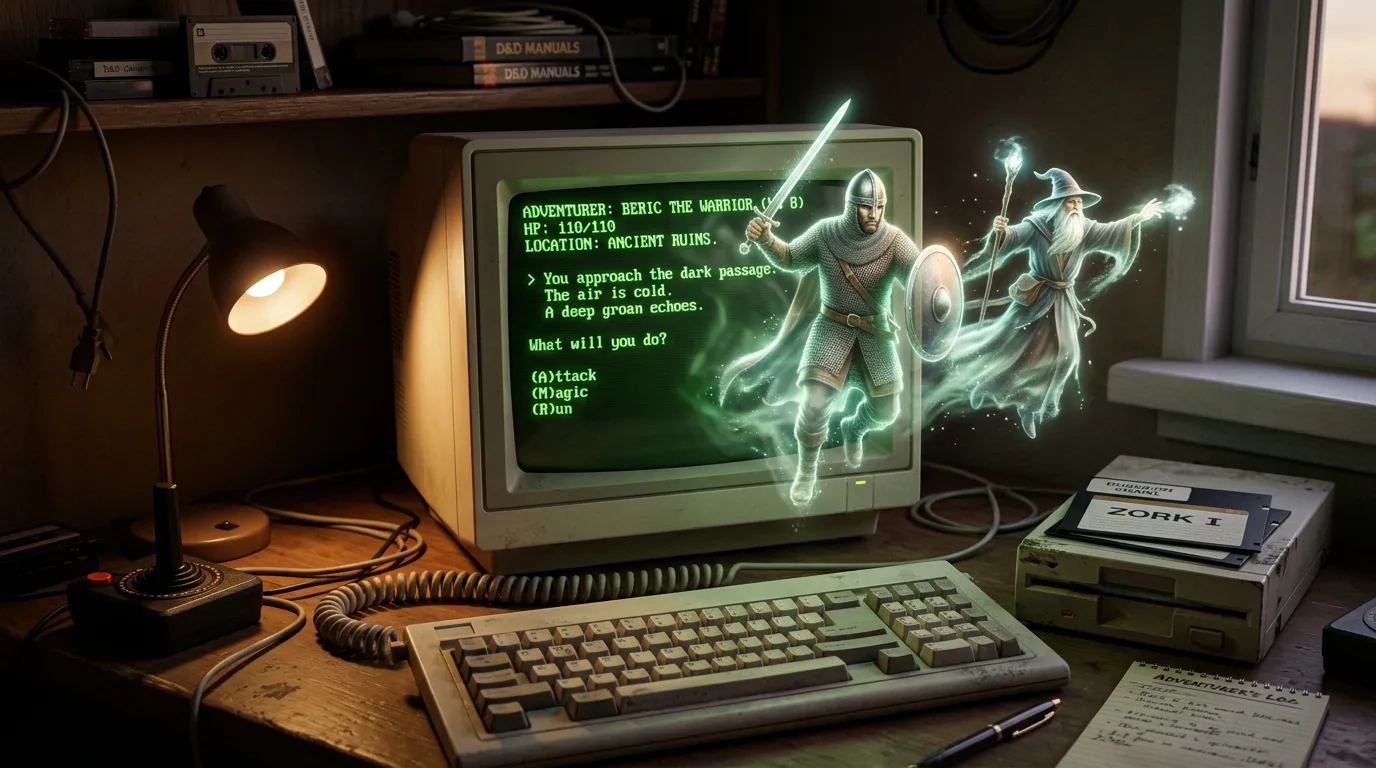
As hardware evolved, text-based games took center stage in the late 1970s and 1980s. Multi-User Dungeons, commonly known as MUDs, captured the imagination of university researchers and tech-savvy hobbyists.
The Rise of MUD1
In 1978, Roy Trubshaw and Richard Bartle created *MUD1* at Essex University. Running on a DEC PDP-10, this text-based virtual world allowed players to connect remotely via ARPANET and British packet-switching networks. Users could explore dungeons, battle monsters, collect treasures, and converse with other players in real time. According to Britannica’s entry on video game history, MUDs bridged the gap between tabletop role-playing games like *Dungeons & Dragons* and modern massively multiplayer online role-playing games (MMORPGs).
Commercialization and Dial-Up Networks
As personal computers penetrated the consumer market in the 1980s, online gaming began to shift from university mainframes to household telephone lines. Services like CompuServe, Prodigy, and later America Online (AOL) introduced dial-up gaming.
| Online Service | Launch Year | Notable Gaming Feature |
|---|---|---|
| CompuServe | 1969 (Gaming later) | Text-based multiplayer titles |
| Quantum Link (Q-Link) | 1985 | Commodore 64 graphics games |
| GEnie | 1985 | Multiplayer fantasy text games |
| Sierra Network | 1991 | Graphical online multiplayer |
These platforms charged users by the hour, yet millions gladly paid to experience the thrill of playing against human opponents miles away without leaving their living rooms. This commercial boom set the stage for the high-speed, global gaming ecosystem we navigate today.
Summary
Discover the true origin of the first online game, tracing its roots from 1970s university mainframes, PLATO systems, and ARPANET experiments to early commercial dial-up networks. Learn how pioneers of networked play shaped modern multiplayer entertainment.
Conclusion
Tracing the evolution of the first online game reveals a remarkable journey of human ingenuity and technological persistence. From humble terminal experiments at university labs to massive global networks connecting millions, early digital pioneers built the bedrock for modern interactive entertainment.

Discussion (0)
Join the conversation