
Smart contracts transform digital trust from a human promise into executable, verifiable logic. By combining cryptographic signatures, distributed ledgers, and deterministic computation, they let parties coordinate value and obligations without relying on a central operator. This section examines their meaning, layered architecture, and principal components.
Smart Contracts: Definition, Architecture, and Core Components
How smart contracts work
At its core, a smart contract is software deployed to a blockchain that automatically evaluates conditions and performs predefined actions. Its smart contract definition therefore extends beyond a conventional legal agreement: it describes a tamper-resistant program whose rules are transparent, traceable, and enforced by network consensus. When a user submits a transaction, participating nodes execute the same instructions and validate the resulting state transition.
The architecture typically includes four layers. The application layer presents interfaces through which users, wallets, or other services submit requests. The code layer contains business rules written in a blockchain-compatible language and compiled into bytecode. The execution layer, often a virtual machine, processes that bytecode within strict resource limits. Finally, the ledger and consensus layers record outcomes and ensure that independent nodes agree on one authoritative state. Ethereum smart contract documentation provides a widely recognized example of this model, including account behavior, transaction execution, and gas accounting.
Core components and operational controls
- State variables: Persistent values such as balances, ownership records, permissions, and status flags.
- Functions: Callable operations that read or modify state, subject to access rules and validation checks.
- Events: Structured logs that help applications monitor significant actions without changing contract storage.
- Modifiers and permissions: Reusable controls that restrict execution to authorized users or approved conditions.
- Oracle interfaces: Carefully designed inputs that connect on-chain logic with external data, such as prices, weather, or delivery status.
Because ledger data is replicated, deployed code is difficult to alter without an explicit upgrade mechanism. This immutability strengthens accountability but makes defects costly; testing, formal verification, access-key management, and emergency safeguards are essential. The NIST blockchain technology overview similarly emphasizes distributed consensus, cryptographic integrity, and the security implications of shared state. Properly engineered, smart contracts provide automation with auditable evidence, reducing ambiguity while preserving a clear record of who authorized each action and when.
How Smart Contracts Create Digital Trust
Digital trust depends on more than a promise between parties. It requires verifiable rules, predictable execution, and evidence that records have not been altered. Smart contracts address these requirements by embedding agreement logic in software deployed on a blockchain. Once authorized conditions are satisfied, the network validates the transaction and records the resulting state through a consensus process. This reduces dependence on a central intermediary and creates a shared, tamper-resistant source of truth.
Why smart contracts reduce uncertainty
The essential principle is deterministic execution. Each participant can inspect the programmed conditions, understand the permitted inputs and outputs, and independently verify the resulting transaction. A smart contract definition therefore extends beyond automated text: it is an executable protocol whose behavior is constrained by code, cryptographic signatures, and the ledger’s validation rules. This structure limits discretionary intervention and makes operational commitments measurable.
Trust also comes from transparency. Public networks allow users, auditors, and regulators to examine transaction histories and compare recorded outcomes with the governing logic. Technical references such as Ethereum smart contract documentation explain how deployment, function calls, gas consumption, and event logs work in practice. These mechanisms make it easier to trace responsibility, reproduce results, and identify abnormal activity without relying solely on an institution’s internal database.
Security, automation, and accountability
Automation can strengthen controls by enforcing permissions, payment thresholds, delivery milestones, or compliance checks immediately. For example, a supply-chain agreement may release funds only after a signed delivery record and an approved sensor reading are confirmed. Because settlement follows predefined rules, counterparties gain faster processing and fewer opportunities for manual error. However, trustworthy automation requires secure keys, carefully tested code, reliable data feeds, and clearly defined recovery procedures.
Digital trust is not equivalent to perfect trust. Bugs, flawed assumptions, oracle manipulation, and governance disputes can still produce valid but undesirable outcomes. Effective implementations therefore combine formal verification, independent audits, access controls, monitoring, and upgrade policies. Guidance such as the NIST blockchain technology overview can help organizations evaluate architecture, risk, and operational responsibilities. When technical assurance is aligned with legal enforceability and sound governance, blockchain-based agreements become a practical foundation for dependable digital transactions.
Smart Contracts Execution, Oracles, and Blockchain Consensus
Execution begins when a user or application submits a transaction containing encoded function arguments. Network nodes simulate the requested operation against the contract’s current state. If validation succeeds, each node proposes the same state transition; fees compensate computation and discourage denial-of-service workloads. Unlike conventional servers, execution is deterministic: identical inputs, code, and prior state must produce an identical result. This property makes automated agreements auditable, but it also means that code cannot safely depend on local time, random values, or private off-chain data.
How smart contracts obtain external facts
Oracles bridge distributed ledgers and the outside world. They deliver data such as exchange rates, weather readings, shipment events, or election results to an on-chain application. Because an oracle can become a single point of manipulation, robust designs use multiple independent providers, cryptographic signatures, threshold aggregation, and reputation or staking mechanisms. Developers should also specify freshness limits, fallback behavior, and circuit breakers. The smart contract definition therefore includes not only executable logic, but also assumptions about data provenance and failure handling. Oracle responses are inputs, not unquestionable truth.
Consensus determines which transactions become authoritative and in what order. In proof-of-work systems, miners compete to append blocks by expending computational energy. Proof-of-stake networks instead assign proposing and validation rights according to bonded assets, while penalties can target equivocation or censorship. Finality rules reduce the risk that a confirmed transaction will later be reversed. Consequently, smart contracts inherit the blockchain’s security model: a sound program cannot compensate for weak validator incentives, chain reorganizations, or insufficient economic security.
Engineering for reliable execution
Auditors analyze code paths, access controls, arithmetic, reentrancy, upgrade mechanisms, and gas consumption. Formal verification can prove selected invariants, while test networks expose integration and oracle defects before deployment. Teams should consult Ethereum smart contract documentation for platform-specific execution behavior and use the NIST blockchain technology overview to compare architectural risks. Because deployed bytecode may be difficult to change, governance, monitoring, and carefully constrained upgrades are as important as syntax. The result is a trust-minimized system grounded in transparent rules, verifiable computation, and explicit operational limits.
Security Risks and Auditing Strategies for Smart Contracts
Smart contracts execute deterministic logic on a blockchain, but their immutability can turn software defects into permanent financial or operational exposure. A flawed authorization check, missing validation, reentrancy path, or unsafe dependency may allow an attacker to manipulate state or drain assets. Risk analysis should cover code, configuration, and the surrounding application, not merely the source.
A precise smart contract definition should identify trust assumptions, permitted callers, asset flows, and failure behavior. Before deployment, teams should model threats including oracle manipulation, privilege escalation, denial of service, signature replay, flash-loan abuse, and economic attacks. Static analyzers can detect reentrancy patterns, integer errors, unreachable branches, and dangerous external calls, but automated findings require human review of business invariants.
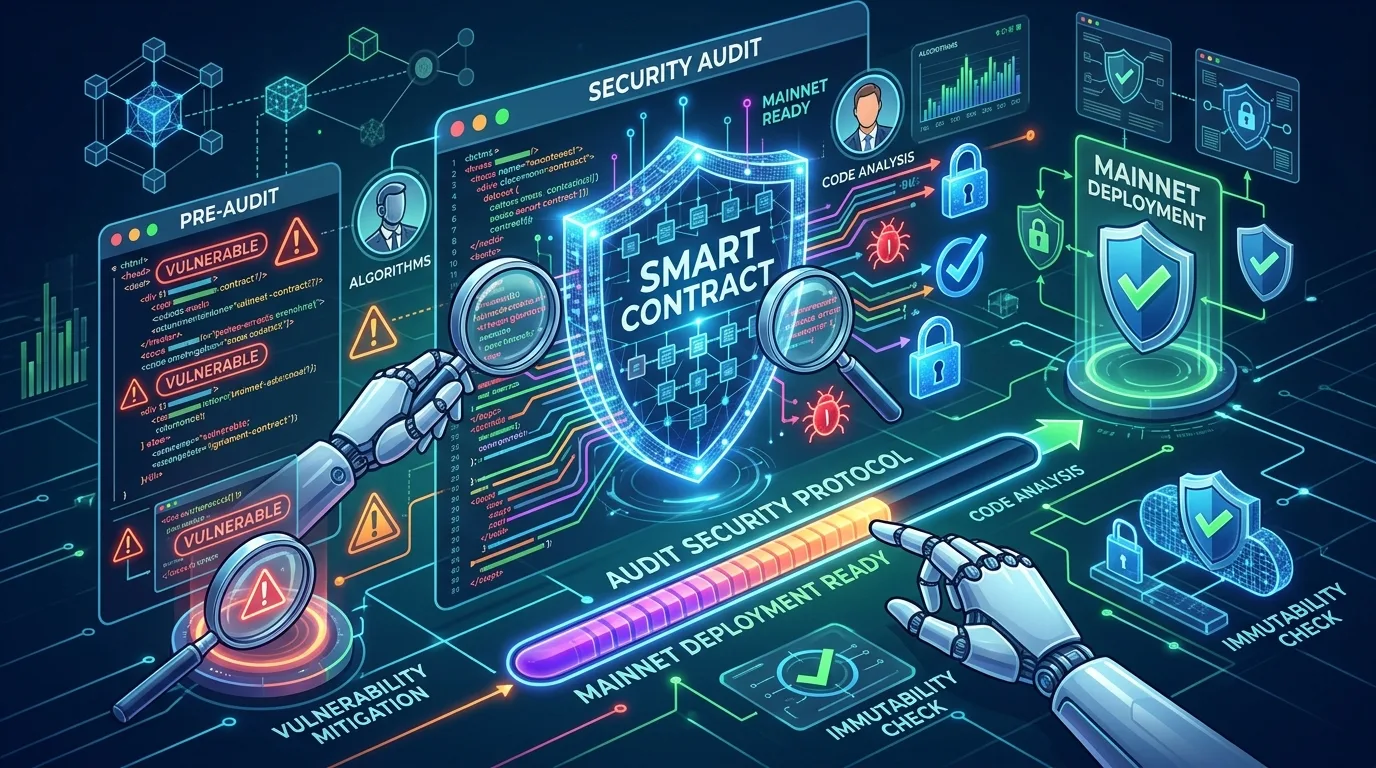
Auditing smart contracts before deployment
A layered audit begins with reproducible builds and peer-reviewed requirements. Auditors inspect access-control boundaries, upgrade proxies, storage layouts, arithmetic assumptions, event emissions, and interactions with tokens or lending protocols. They combine manual review with fuzz testing, property-based tests, symbolic execution, and differential testing against a reference implementation. Formal specifications are valuable for invariants such as “total liabilities never exceed collateral” or “only governance can change parameters.”
The audit report should classify findings by exploitability and impact, document proof-of-concept tests, and state residual risk rather than promise absolute safety. Independent reviewers should verify remediation in a second pass. For live systems, monitoring must track unusual calls, balance changes, oracle deviations, and governance events. Circuit breakers, rate limits, pause controls, and governed upgrade mechanisms can reduce blast radius, although each introduces complexity.
Operational assurance and incident readiness
Security continues after launch because dependencies, compiler behavior, and attack techniques evolve. Teams should pin compiler versions, rotate privileged keys through multisignature controls, separate deployment from administration, and maintain an incident response playbook. Bug bounties and staged releases create external feedback without exposing full value at once. Governance should define who can pause funds, approve upgrades, and communicate disclosures. Reviewing Ethereum smart contract documentation alongside a NIST blockchain technology overview helps align engineering controls with platform guidance.
Enterprise Applications of Smart Contracts
In enterprise environments, smart contracts translate agreed business rules into deterministic software that executes when predefined conditions are satisfied. Their value extends beyond automated payments: they coordinate approvals, record state transitions, enforce time limits, and provide tamper-evident evidence for audits. Because every participating node validates the same transaction logic, organizations can reduce reconciliation effort while preserving a shared operational history across firms, departments, or supply-chain tiers.
Governance patterns for smart contracts
Financial institutions use these programmable agreements for trade finance, syndicated lending, collateral management, and automated settlement. A lender can release funds after verified milestones, while counterparties receive consistent status updates without relying on a single database administrator. In insurance, claims platforms can combine policy terms with validated event data, triggering payments when loss conditions are met and reducing manual adjudication.
Manufacturers and logistics providers apply distributed ledgers to provenance, inventory, and compliance. Each custody transfer can be time-stamped and associated with a digital identity, creating an auditable chain from raw material to finished product. Procurement systems can also validate certificates, match invoices with delivery records, and flag deviations before payment. A precise smart contract definition is therefore essential: ambiguous business language must be converted into testable states, permissions, exceptions, and settlement rules.
Healthcare networks use automated workflows to manage consent, credential verification, research access, and controlled data exchange. The ledger should store proofs or references rather than sensitive clinical content, with encryption and off-chain repositories protecting confidentiality. Before deployment, engineering teams should compare implementation behavior with Ethereum smart contract documentation and relevant enterprise standards, then conduct formal testing, threat modeling, and independent code review.
- Identity: role-based permissions and verifiable credentials limit who may submit or approve transactions.
- Privacy: channels, zero-knowledge proofs, and selective disclosure minimize unnecessary exposure.
- Resilience: deterministic execution, monitoring, and recovery procedures reduce operational failure.
- Compliance: policy controls, retention rules, and audit trails support regulated processes.
Successful programs treat smart contracts as components of a broader control architecture, not replacements for governance. Legal enforceability, key management, oracle reliability, upgrade procedures, and dispute resolution must be designed together. Teams can use the NIST blockchain technology overview to frame risk assessment, while performance testing confirms that transaction throughput, latency, and finality meet business requirements.
Smart Contracts: Governance, Regulation, and Future Outlook
Smart contracts are moving from experimental blockchain applications into infrastructure for finance, supply chains, digital identity, insurance, and public administration. Their appeal rests on deterministic execution: once predefined conditions are satisfied, code initiates an agreed action without requiring a central intermediary. However, technical autonomy does not eliminate legal, operational, or governance responsibilities. A sound smart contract definition must therefore address both executable logic and the rights, remedies, and obligations surrounding it.
Smart Contracts and Regulatory Accountability
Regulators increasingly assess blockchain-based agreements through existing frameworks covering securities, payments, consumer protection, data privacy, and anti-money-laundering controls. Code may automate performance, but it cannot independently establish legal intent, jurisdiction, or liability. Organizations should map each protocol to accountable operators, maintain audit trails, document consent, and provide mechanisms for dispute resolution. Where personal data is involved, immutable storage can conflict with correction and erasure requirements, making privacy-preserving architectures essential. Technical teams can consult resources such as the Ethereum smart contract documentation and the NIST blockchain technology overview when designing controls, but compliance remains context-dependent.
Governance, Security, and Operational Risk
Decentralized applications require governance models for upgrades, emergency pauses, oracle failures, and disputed transactions. Multisignature administration, transparent voting procedures, timelocks, and independent audits can reduce unilateral control, although each introduces trade-offs. Formal verification helps prove that critical properties hold under defined assumptions; it does not guarantee that the specification reflects business intent. Secure key management, continuous monitoring, incident response, and reproducible deployment pipelines are equally important. Governance should also define who can change parameters and how affected users are notified.
- Legal alignment: connect executable rules with enforceable agreements and jurisdictional requirements.
- Resilience: test edge cases, oracle manipulation, congestion, and dependency outages.
- Transparency: publish risks, permissions, audit findings, and upgrade policies in accessible language.
- Inclusion: preserve human support for users who cannot safely manage wallets or cryptographic keys.
Future Outlook
Future adoption will depend on interoperable standards, clearer legal recognition, scalable execution, and trustworthy data inputs. Hybrid designs that combine on-chain verification with regulated institutions and confidential computation are likely to outperform purely autonomous models. In conclusion, smart contracts will not replace governance; they will make governance more explicit, auditable, and programmable. Their lasting value will come from integrating reliable code with accountable institutions, practical safeguards, and evolving public policy.
Frequently Asked Questions
What is a smart contract?
A smart contract is a self-executing digital agreement written in code and stored on a blockchain. It automatically enforces the terms of an agreement when predefined conditions are met, reducing the need for intermediaries.
How do smart contracts create digital trust?
Smart contracts create trust through transparency, automation, and tamper-resistant blockchain records. All participants can verify the contract’s rules and transactions, reducing reliance on a central authority or personal assurances.
What are the main benefits of smart contracts?
Smart contracts can reduce costs, speed up transactions, and minimize errors associated with manual processing. They also improve accountability because contract actions are recorded and can be independently verified on the blockchain.
What industries can use smart contracts?
Smart contracts can be used in finance, real estate, supply chain management, insurance, healthcare, and digital identity. For example, they can automate loan payments, verify product shipments, or transfer property ownership when conditions are satisfied.
What are the risks and limitations of smart contracts?
Smart contracts execute exactly as programmed, so coding errors or vulnerabilities can lead to unintended results. They may also face legal, regulatory, scalability, and data-accuracy challenges, especially when they depend on information from the real world.


Discussion (0)
Join the conversation