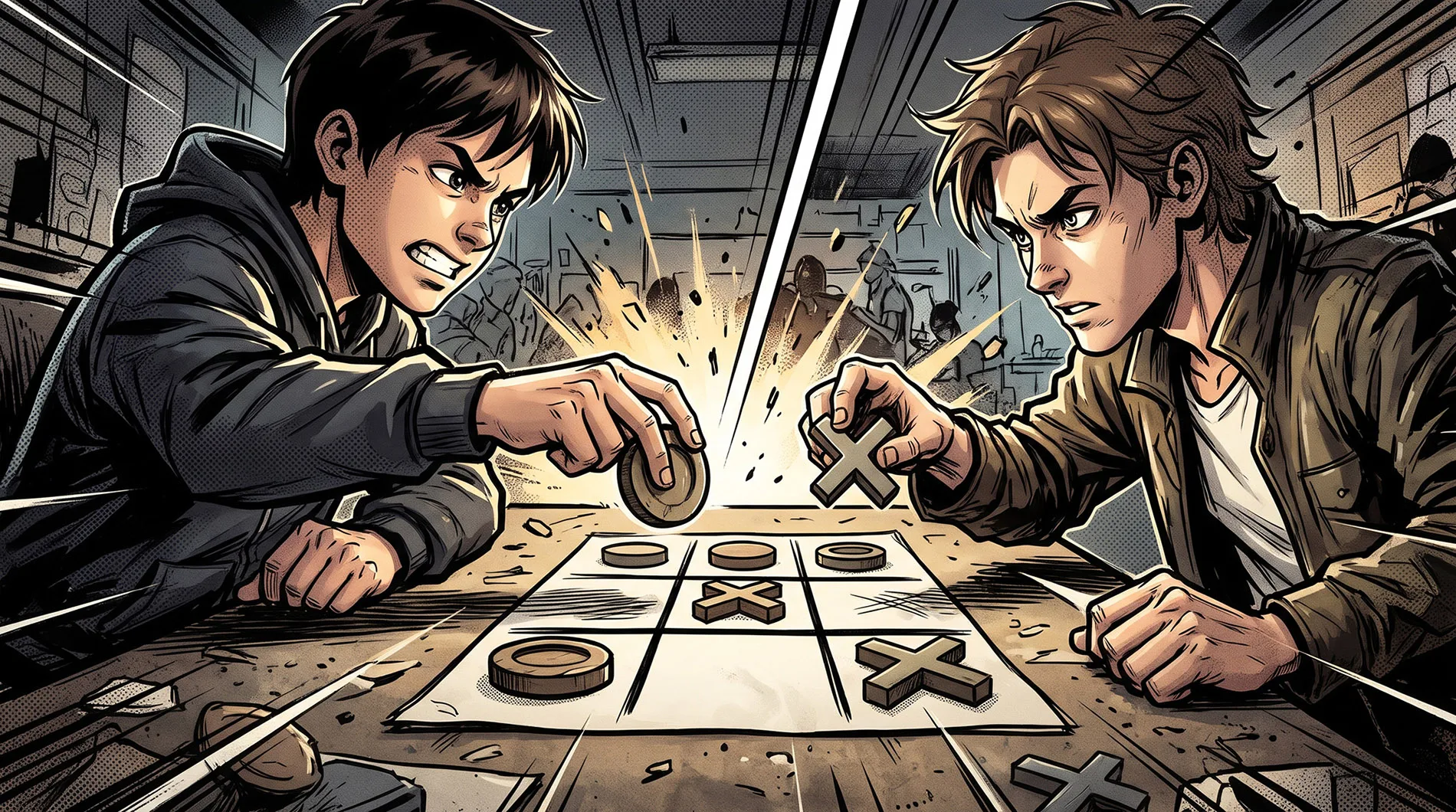
Online tic-tac-toe transforms a familiar paper-and-pencil game into a real-time, rule-driven system for two remote players. Although the board is small, a well-designed implementation must coordinate state, validate moves, detect terminal positions, and present identical information to both participants without ambiguity.
Online Tic-Tac-Toe Fundamentals and Core Rules
At its foundation, the game uses a three-by-three grid containing nine distinct cells. Two players compete under alternating turns: one controls X and the other controls O. The objective is to place three identical marks in a continuous horizontal, vertical, or diagonal line before the opponent does so. If every cell is occupied without either player forming a line, the result is a draw. These rules are simple enough for immediate play, yet precise enough to define a complete state machine for software.
How online tic-tac-toe represents the board
A digital board is commonly represented as an indexed array with nine positions, each holding X, O, or an empty value. The interface maps every visible square to one unique index, allowing the game server to process a selection deterministically. A move is legal only when the selected index exists, belongs to the current game, and is still empty. The client may display a hover effect or animation, but visual feedback must never substitute for authoritative validation on the server.
In online tic-tac-toe, the shared game state should include the board contents, the identity of both players, the mark assigned to each player, whose turn is active, and the current status: waiting, active, won, lost, or drawn. A move normally carries a game identifier, player identity, and cell index. The server verifies these values, updates the state atomically, and broadcasts the resulting position. This prevents duplicate submissions, stale interfaces, and conflicting moves when both clients act nearly simultaneously.
Turn order, legal moves, and synchronization
Turn management is a strict sequencing rule rather than a presentation preference. The first participant is usually assigned X, although a platform may randomize or alternate that advantage across matches. After a valid placement, control passes to the other participant. Requests from a player who is not active, has already completed the game, or is not authenticated for the match must be rejected. In a networked setting, the server timestamp or event sequence should determine ordering, not the arrival order assumed by an individual browser.
- Valid cell: the coordinate must be within the nine-cell board.
- Empty position: an occupied cell cannot be overwritten.
- Correct participant: only the player assigned to the active mark may submit.
- Active match: moves are refused after a win, draw, cancellation, or timeout.
- Consistent state: the accepted move must be applied once and distributed to both clients.
Reliable synchronization is especially important in online tic-tac-toe because a fast interface can make a move appear complete before the server confirms it. A persistent connection, often implemented with the WebSocket API, can deliver low-latency events such as match creation, opponent joining, move acceptance, rejection, and game completion. If the connection drops, the client should mark its view as temporarily uncertain and reconcile it with the server rather than permitting speculative moves to continue unchecked.
Winning combinations and draw detection
There are exactly eight winning combinations on a three-by-three board: three rows, three columns, and two diagonals. After each accepted move, the rules engine checks only combinations that include the newly occupied cell, although checking all eight combinations is also computationally trivial. A win is recorded immediately when one combination contains the same nonempty mark in all three positions. The game must then become immutable, preventing later requests from changing the recorded result.
- Apply the validated mark to the selected cell.
- Evaluate the relevant rows, columns, and diagonals.
- If a complete line exists, assign victory to the player who moved.
- If no line exists and all nine cells are occupied, assign a draw.
- Otherwise, switch the active player and await the next move.
For online tic-tac-toe, outcome detection should be centralized in a trusted rules module so that browser behavior, replay records, and match statistics use the same logic. An AI opponent may evaluate future positions with a minimax algorithm, but that search strategy is separate from rule enforcement. The server still decides whether a move is legal and whether the resulting position ends the match.
Fair play and clear player feedback
A professional interface communicates whose turn it is, confirms accepted actions, and explains rejected requests without exposing unnecessary technical details. It should distinguish a draw from a win, identify the winning line, and offer a rematch only after both participants understand that the previous state is closed. By combining deterministic validation, synchronized state transitions, and accessible status messages, online tic-tac-toe remains fair, understandable, and technically robust even when network timing is imperfect.
How Online Tic-Tac-Toe Matchmaking Works
Matchmaking is the coordination layer that turns a casual board game into a responsive, fair, and reliable multiplayer experience. In online tic-tac-toe, the system must do more than locate an available opponent. It must verify player identity, interpret preferences, assign compatible competitors, establish a synchronized game session, and recover gracefully when a connection fails. Although the rules are simple, these requirements involve several distributed-system concerns, including state management, latency control, validation, and abuse prevention.
How online tic-tac-toe matchmaking begins
The process starts when a player selects a game mode and enters a matchmaking queue. The client sends a request containing an authenticated player identifier, preferred time control, region or language settings, and sometimes a rating range. The server validates the request before placing it in the queue. This prevents malformed data, duplicate queue entries, and unauthorized attempts to manipulate the pairing service.
A typical queue stores each waiting player as a short-lived record. That record may include an entry timestamp, skill rating, connection status, and a unique request token. The token is important because mobile users can tap a button twice, refresh a page, or lose connectivity while the first request is still being processed. An idempotent matchmaking service can recognize repeated requests and maintain one active queue position instead of creating multiple opponents for the same person.
For a basic online tic-tac-toe service, the matching policy can initially prioritize the oldest compatible request. Compatibility may mean the same game variant, acceptable rating difference, and supported region. As the waiting time increases, the server can gradually widen the rating interval. This approach balances competitive fairness against queue speed: narrow constraints produce better skill alignment, while flexible constraints reduce abandonment during quiet periods.
Pairing, reservations, and race conditions
When two requests become compatible, the matchmaking worker must reserve both players atomically. Without a reservation step, two workers could select the same player at nearly the same moment and create conflicting games. A database transaction, distributed lock, or compare-and-set operation can ensure that only one worker claims a queue record. After successful pairing, the service creates a match identifier and changes both records from waiting to matched.
The match record normally includes the two player identifiers, assigned symbols, creation time, rule set, and a status such as pending, active, completed, or cancelled. Symbol assignment should be generated by the server rather than chosen by the clients. Randomization is usually sufficient, although some platforms alternate first move privileges to maintain long-term balance. A server-side assignment also prevents a modified client from claiming the more favorable turn.
After the reservation, each participant receives a match notification containing a non-guessable session token. The clients then connect to the game service through a persistent channel, commonly using the WebSocket API. This channel allows the server to push the opponent’s moves immediately instead of requiring repeated polling. If a persistent connection is unavailable, short polling or server-sent events can provide a fallback, though these methods may increase latency or infrastructure overhead.
Synchronizing the game board
The server must remain authoritative throughout an online tic-tac-toe session. Clients may render the board and animate moves, but they should not decide whether a move is legal. A move request should identify the match, player, turn sequence, and selected cell. The server verifies that the session is active, the requester owns the relevant symbol, the submitted sequence matches the current version, and the selected cell is empty.
Once validated, the server applies the move to its canonical board, increments a revision number, evaluates the position, and broadcasts the resulting state. The revision number protects against stale messages and duplicate submissions. If two requests arrive close together, only the request matching the current turn and revision is accepted. This design makes the operation deterministic even when network packets arrive out of order.
Clients should treat server updates as authoritative snapshots or confirmed events. Optimistic rendering can make the interface feel faster, but an unconfirmed move must be reversible if the server rejects it. A robust client therefore tracks pending actions, acknowledges confirmed revisions, and requests a fresh state when it detects a gap in the event sequence.
Ratings, rematches, and queue quality
Some online tic-tac-toe platforms use ratings to improve future pairings. A win, loss, or draw updates a numerical score after the match is verified. The rating system should calculate results from server records, not client declarations. For a solved game such as tic-tac-toe, a simple rating adjustment is often adequate; advanced systems may use uncertainty values to match new players more efficiently.
Rematch functionality should create a new queue request rather than silently reusing the previous game. This prevents stale sessions from receiving new moves and gives both players an explicit opportunity to continue. The service can also apply a short rematch cooldown or avoid immediate repeated pairings when a larger player pool is available.
For computer opponents, matchmaking routes the player to an automated game service instead of another human queue entry. The bot evaluates legal board states and selects a move according to its configured difficulty. A minimax algorithm can provide optimal play, while deliberately limited search depth, heuristic scoring, or randomized choices can produce easier levels. The server should still validate and record bot moves using the same state model as human moves.
Disconnects, timeouts, and fairness
Network failure is normal, so an online tic-tac-toe platform needs explicit lifecycle rules. A temporary disconnect can place a player in a grace period while the server preserves the match. If the player reconnects with a valid session token, the service sends the latest board revision and resumes play. If the timeout expires, the rules may award a forfeit, record a cancellation, or classify the result separately for rating purposes.
Heartbeats help distinguish a slow client from a closed connection. The server can send periodic keep-alive messages and remove sessions that fail to respond after a defined interval. These limits should be long enough to tolerate ordinary mobile network changes but short enough to prevent abandoned matches from consuming resources indefinitely.
Finally, matchmaking infrastructure should expose operational metrics such as average queue time, pairing success rate, disconnect frequency, rejected move count, and match completion rate. Monitoring these measures helps engineers identify overloaded regions, faulty clients, and unfair timeout settings. The result is a faster and more trustworthy online tic-tac-toe experience in which pairing, gameplay, and recovery follow predictable technical rules.
Winning Strategies for Two-Player Tic-Tac-Toe
Winning consistently requires more than selecting an empty square at random. In online tic-tac-toe, every move changes the opponent’s available threats, creates future restrictions, and may determine whether the game ends in a win or a draw. The strongest players therefore treat the board as a changing decision system. They evaluate immediate tactics, anticipate the opponent’s reply, and select moves that preserve more than one route to victory.
Core Principles for online tic-tac-toe
The first principle is to control the center whenever it is safely available. The center participates in four possible winning lines, while a corner participates in three and an edge in only two. Taking the center gives a player greater flexibility and forces the opponent to respond carefully. If the center is occupied, a corner is usually the next most valuable choice. Edges are useful defensively, but opening with one often gives the opponent stronger positional options.
A second principle is to distinguish between an immediate threat and a developing threat. An immediate threat has two marks in a line and an open third square, so it must be blocked at once. A developing threat may not win on the next move, but it can restrict the opponent’s choices or prepare a fork. Strong play considers both categories instead of focusing only on the last move made.
Creating and Preventing Forks
A fork is a move that creates two separate winning threats simultaneously. Because the opponent can normally block only one of them, a properly constructed fork is often decisive. Corners are especially important in fork patterns: a player can use one corner to connect with the center and another corner, or to establish two diagonal and row-based possibilities.
To create a fork, first identify squares that belong to multiple potential winning lines. Then examine whether the opponent can occupy that square or force a response before the fork develops. Do not assume that placing a mark near several friendly marks automatically creates a fork; the intervening squares must remain accessible, and the opponent must lack a tactical interruption.
Preventing forks requires a wider defensive scan. If the opponent has two marks arranged in a way that could support a double threat, block the most dangerous formation before it becomes concrete. Sometimes the correct defense is not to complete your own line, but to occupy a neutral square that removes the opponent’s fork square. This is a key difference between reactive play and calculated board control.
Opening and Response Strategy
A strong online tic-tac-toe opening depends on whether you move first or second. As the first player, begin in the center or a corner. The center maximizes direct influence; the corner can create less obvious diagonal patterns. If the opponent starts in a corner, claim the center when possible. If the opponent starts in the center, choose a corner rather than an edge, because corners provide more opportunities to build a fork.
When responding to a corner opening, taking the opposite corner may be valuable if the center is unavailable, but the move must be checked for tactical consequences. Against an edge opening, the center is generally the most efficient reply. These guidelines are not rigid rules: a forced win, a required block, or an available fork always takes priority over general positional preferences.
Defensive Calculation and Move Ordering
When playing online tic-tac-toe, analyze candidate moves in a disciplined order. First, ask whether you can win immediately. Second, check whether the opponent can win immediately and block that line. Third, search for a move that creates a fork. Fourth, identify and prevent the opponent’s fork. Only after these tactical questions are answered should you compare positional improvements such as central control or corner access.
- Winning move: Complete a line if the square is available.
- Forced block: Remove an opponent’s immediate winning possibility.
- Fork creation: Choose a move that produces two independent threats.
- Fork prevention: Occupy or eliminate the square that enables the opponent’s double threat.
- Positional improvement: Prefer center, corner, and line flexibility over a low-impact edge.
This move ordering prevents a common error: pursuing an attractive attack while ignoring a direct defensive obligation. It also makes analysis efficient because most positions can be resolved by tactical priority before deeper strategic comparison is necessary.
Perfect Play and Digital Implementation
For a software opponent, the minimax algorithm can evaluate every legal continuation from the current board and assign outcomes for win, loss, or draw. Because the game has a very small state space, exhaustive search is practical. The implementation should also reject invalid states, enforce alternating turns, and verify that a game cannot continue after a winning line has been formed.
In a networked match, fair timing and authoritative state management matter as much as board evaluation. A server using the WebSocket API can broadcast each validated move with low latency, while the server—not the browser—should determine whose turn it is and whether the move is legal. Clients should render confirmed state, handle disconnections, and prevent duplicate submissions.
The best online tic-tac-toe players combine tactical urgency with positional judgment. They look for wins first, blocks second, forks third, and strategic improvements only after immediate risks are resolved. With consistent move ordering, accurate threat recognition, and disciplined use of center and corner squares, even a simple three-by-three board becomes a precise exercise in adversarial reasoning. The best online tic-tac-toe results come from reducing the opponent’s choices while preserving multiple winning possibilities of your own.
Building a Reliable Online Tic-Tac-Toe Experience
A polished online tic-tac-toe game is more than a nine-cell board and a turn button. Reliability depends on coordinating interface state, server validation, player identity, network events, and recovery behavior. The client should feel immediate, but the server must remain authoritative. This separation prevents a modified browser, duplicated request, or delayed packet from corrupting the match. A dependable implementation treats every move as a validated state transition rather than as a visual action performed only in the browser.
Designing an online tic-tac-toe state model
The foundation of online tic-tac-toe is a small, explicit game state. A useful model includes a unique match identifier, two player identifiers, the board represented as nine positions, the active symbol, a move counter, a status value, and an optional winner or draw result. Keeping these fields separate makes the system easier to test and serialize. The move counter is especially valuable because it provides a monotonic version number that clients can use to detect stale updates.
When a player selects a square, the client can render a provisional mark for responsiveness, but it should immediately send a command containing the match ID, selected cell, player identity, and expected version. The server then checks that the match exists, the sender belongs to it, the player is allowed to act, the submitted version is current, the square is empty, and the match is still active. If all conditions pass, the server commits the move, increments the version, evaluates the result, and broadcasts the new state. Invalid commands should produce a structured error without changing the board.
Managing real-time communication
Real-time play requires an event channel that can deliver moves, confirmations, resignations, rematches, and connection updates. A persistent socket connection is usually preferable to repeated polling because it reduces latency and avoids unnecessary requests. The WebSocket API is a common browser-level option, although the transport should be hidden behind an application-specific messaging layer. That abstraction allows the game to add authentication, message validation, reconnection rules, and telemetry without coupling core logic to one protocol.
Every event should have a predictable envelope. Include an event type, match ID, server timestamp, state version, and payload. Clients must process events idempotently: receiving the same move twice should not place two marks or advance the interface twice. A client can ignore an event whose version is less than or equal to its current version, apply the next expected version, and request a full snapshot when a version gap appears. This approach handles duplicated, delayed, or reordered messages without relying on luck.
Protecting fairness and game integrity
Security and fairness are closely related in online tic-tac-toe. Never trust a symbol, turn indicator, winner value, or board sent by the browser. The server should derive these values from the stored match state. Authentication may be lightweight for casual play, but each session still needs an unambiguous player token, expiration policy, and authorization check. Rate limits should restrict rapid command submission, while schema validation rejects oversized, malformed, or unexpected payloads before they reach game logic.
- Atomic moves: update the board and version in one transaction so concurrent commands cannot occupy the same cell.
- Server-side outcomes: calculate wins and draws from the committed board rather than accepting client claims.
- Replay resistance: associate commands with a request ID or version so retries cannot create extra turns.
- Observable failures: record rejected actions, disconnects, and state conflicts without exposing sensitive session data.
For computer opponents, the same authority rule applies. Difficulty settings should be implemented on the server or in a trusted service when competitive integrity matters. A basic bot may choose randomly from legal cells, while a stronger bot can use the minimax algorithm to evaluate possible outcomes. The browser should receive only the resulting legal move, not privileged decision data that could reveal internal strategy or allow tampering.
Handling disconnections and recovery
Network failure is normal, particularly on mobile devices. A reliable online tic-tac-toe product should distinguish temporary connectivity loss from deliberate departure. The interface can show a reconnecting state, disable ambiguous controls, and preserve the last confirmed board locally. On reconnection, the client should re-authenticate, identify the match, and request the authoritative snapshot. It should not blindly replay every locally displayed action, because a provisional move may never have been accepted.
Match services also need lifecycle policies. A disconnected player might receive a grace period before forfeiting, while an abandoned lobby can expire automatically. These rules should be visible before play begins and represented as explicit server events. If a match is restored after a timeout, the client must receive a clear terminal status rather than attempting to resume an invalid turn. Recovery is successful only when both players converge on the same state and understand why the state changed.
Testing the complete player journey
Unit tests should cover win detection, draw detection, turn enforcement, malformed commands, repeated requests, and every board position. Integration tests should run two clients against the same match and introduce delayed delivery, duplicate events, reconnects, and simultaneous moves. Property-based tests are particularly effective for board logic: regardless of input order, the service should never produce more than one mark per cell, should never allow play after a terminal result, and should always preserve valid move counts.
Finally, measure the experience in production. Useful metrics include command-to-confirmation latency, rejected-command rates, reconnect frequency, match completion rates, and the percentage of sessions requiring snapshot recovery. These signals reveal whether a seemingly simple online tic-tac-toe game remains dependable under real conditions. When authoritative state, resilient messaging, transparent recovery, and focused testing work together, players experience a fast, fair, and trustworthy game rather than a fragile demonstration.
Real-Time Communication, Security, and Fair Play
A convincing multiplayer experience depends on more than rendering a board and accepting clicks. In online tic-tac-toe, every move must reach the opponent quickly, remain consistent across devices, and be validated by a trusted authority. The technical design therefore combines low-latency transport, authoritative game-state management, authentication, and explicit protections against cheating. These concerns are closely related: a weak communication model can create synchronization errors, while an untrusted client can exploit the same gaps to alter results.
Communication Architecture for online tic-tac-toe
Real-time play is best implemented with a persistent bidirectional connection rather than repeated polling. After a player joins a match, the client opens a session with the game server and receives events whenever the opponent moves, disconnects, or requests a rematch. A WebSocket API is a common choice because it supports low-overhead, full-duplex messaging over a single connection. Alternative transports, such as server-sent events paired with authenticated requests, may work for simpler deployments, but they generally require more coordination for client-to-server actions.
Messages should use a small, versioned schema. A move request might contain a match identifier, a cell index, a client-generated request identifier, and the player’s authentication context. The server response should state whether the move was accepted, rejected, or already processed. It should also include the resulting board, active player, move number, and game status. Sending a complete authoritative snapshot after each accepted action is often safer than sending only a cell change, because clients can recover from missed messages without guessing the current state.
Ordering and duplication deserve special attention. Network retries can deliver the same request more than once, and mobile connections can reconnect after a temporary outage. The server should assign a monotonically increasing sequence number to accepted events and treat request identifiers as idempotency keys. A client that receives an event with an old sequence number can ignore it; one that detects a gap can request a fresh snapshot. This approach keeps the interface responsive while preventing divergent boards.
Authoritative State and Resilience
The browser should be treated as an untrusted presentation layer. It may optimistically highlight a selected square, but it must not decide whether that square is legal or whether a player has won. The server maintains the canonical match record, including participants, turn ownership, board contents, move history, and terminal status. Each incoming action is checked against that record before it is broadcast to the other participant.
Validation should be deterministic and narrow. The service needs to confirm that the match exists, the sender belongs to it, the game is still active, the sender owns the current turn, the selected coordinate is valid, and the target cell is empty. It should then apply the move once, evaluate all winning lines, and persist the new version atomically. A database transaction or equivalent compare-and-swap operation prevents two nearly simultaneous requests from claiming the same turn. This is especially important when both players reconnect or when multiple server instances process traffic concurrently.
Availability controls are also part of correctness. Heartbeats can detect stale connections, while a short grace period prevents an ordinary network interruption from immediately producing an unfair forfeit. Match state should survive process restarts, and a reconnecting player should be able to authenticate and obtain the latest snapshot. Rate limits on connection attempts, messages, and rematch requests reduce resource exhaustion without penalizing normal play.
Security Controls for online tic-tac-toe
Authentication establishes identity, but authorization determines what that identity may do. Every move must be associated with the authenticated account or an unguessable match token, not merely with a username supplied by the browser. Match identifiers should be difficult to enumerate, and sensitive session material should be protected with secure, appropriately scoped cookies or short-lived tokens. Transport encryption is essential when credentials, private invitations, or game events cross an untrusted network.
Input handling should reject malformed payloads before they reach game logic. Enforce maximum message sizes, strict data types, valid enumerations, and bounded string lengths. Escape user-controlled display names in the interface to prevent script injection, and apply origin checks when the deployment model requires them. Logs should record security-relevant events such as failed authorization and repeated invalid moves, while avoiding passwords, raw tokens, or unnecessary personal data.
Threat modeling should include client modification, replayed requests, fabricated win claims, and denial-of-service behavior. A user can inspect or alter JavaScript, so hidden fields and disabled buttons provide no security. Server-side validation remains mandatory even when the interface appears correct. Replay protection through sequence numbers, request identifiers, and match-version checks ensures that an old legal move cannot be reused after the board has changed.
Fair Play and Verifiable Results
Fairness means both participants receive the same rules and neither can obtain privileged information. The service should select the first player through a transparent mechanism, record the assignment, and avoid exposing internal state before the match begins. A published rule set should define turn duration, disconnection handling, draw conditions, rematches, and what happens when a player abandons a session. Consistency matters more than complexity; predictable rules are easier to audit and harder to manipulate.
For online tic-tac-toe, the small game space makes verification practical. Store an append-only move history containing the actor, coordinate, server timestamp, sequence number, and resulting state version. The final board can be recomputed from the initial state and the accepted history, allowing support staff or automated systems to investigate disputes. A compact state digest, generated after each move, can further demonstrate that the server did not silently rewrite the match record.
Automated opponents require a separate fairness policy. If a player competes against software, the interface should disclose that fact and identify the difficulty level. An implementation based on the minimax algorithm may produce optimal play, but the important security principle is that the computer’s decisions occur on the server or are otherwise constrained so that a human client cannot inspect hidden search data. When humans play each other, no client should receive the opponent’s intended move or private matchmaking information.
Finally, moderation and recovery procedures complete the trust model. Provide a mechanism to report abuse, review suspicious matches, and reverse only those outcomes supported by evidence. Clear telemetry, deterministic validation, and resilient synchronization make online tic-tac-toe feel immediate without sacrificing integrity. When communication, security, and fair-play controls are designed together, online tic-tac-toe becomes not merely functional, but dependable under real network conditions and adversarial behavior.
Testing, Optimization, and Future Improvements
A reliable online tic-tac-toe implementation requires more than a functional board and a winning-condition check. The application must preserve game state, synchronize moves between two clients, reject invalid actions, and provide predictable behavior under latency or disconnection. Testing should therefore cover the complete system: interface behavior, client-side validation, server authority, communication protocols, and the persistence of match results. A structured quality strategy helps ensure that the game remains fair and responsive across browsers, devices, and network conditions.
Testing an online tic-tac-toe implementation
Unit tests should begin with the domain model because it contains the rules that must remain deterministic. Test every legal opening move, all eight possible winning lines, drawn positions, attempts to play in occupied cells, and moves submitted after the match has ended. The board representation should also be tested for coordinate consistency; a mismatch between visual cells and internal indexes can produce subtle errors that are difficult to detect through manual play.
Integration testing should then verify the interaction between the user interface, game controller, and backend. A test can simulate two players joining a room, alternating turns, receiving state updates, and leaving before completion. Assertions should confirm that both clients render the same board and that the server rejects a move from the wrong player. These tests are especially important because client-side checks alone cannot protect an online match from modified requests or race conditions.
End-to-end tests should reproduce realistic browser workflows. They can launch two independent sessions, assign player identities, submit moves, reload one client, and verify that the current state is restored. Additional scenarios should include duplicate submissions, delayed responses, reconnect attempts, malformed payloads, and simultaneous moves. For an online tic-tac-toe service, automated browser tests provide valuable coverage for issues that unit tests cannot reveal, such as stale rendering, disabled controls that fail to re-enable, or status messages that contradict the authoritative result.
Performance and reliability optimization
Although the rules of tic-tac-toe are computationally small, the surrounding application can still experience avoidable overhead. Keep messages compact by transmitting the move, match identifier, turn information, and a version or sequence number instead of repeatedly sending unnecessary metadata. The server should validate the sequence number before applying a move, preventing an older packet from overwriting a newer state. When practical, immutable state transitions make debugging easier and reduce accidental mutation across concurrent requests.
Real-time delivery is appropriate for an online tic-tac-toe match because both players need immediate feedback. A persistent connection using the WebSocket API can reduce polling overhead and lower perceived latency, but it should be paired with heartbeat messages, timeout handling, and a reconnection strategy. If a connection fails, the client should display a clear status, stop accepting ambiguous actions, and request a fresh authoritative snapshot after reconnecting. The server must remain the source of truth rather than trusting a board state supplied by either browser.
Performance profiling should measure more than average response time. Track connection establishment, move acknowledgement latency, message throughput, error rates, and reconnect frequency. Load tests can create many short-lived rooms and sustained concurrent matches to reveal resource leaks, inefficient room cleanup, or excessive memory usage. Caching static assets, compressing scripts, and minimizing unnecessary component re-renders can improve responsiveness on mobile devices without complicating the game logic.
Security, fairness, and observability
Even a simple board game needs defensive engineering. Validate every incoming field against a strict schema, enforce room membership, authorize the player associated with each turn, and rate-limit repeated requests. Never rely on hidden interface controls as a security boundary. If anonymous sessions are supported, use unpredictable room identifiers and avoid exposing personal data in logs or client messages. Output encoding is also necessary wherever usernames or chat-like labels are displayed.
Observability helps diagnose failures without reproducing them manually. Structured logs should record match creation, player assignment, accepted moves, rejected moves, disconnects, and terminal outcomes. Avoid logging sensitive tokens, but include correlation identifiers that connect events from the browser, application server, and message layer. Metrics for abandoned games and state divergence can reveal usability or infrastructure problems that ordinary error monitoring misses.
Future improvements for online tic-tac-toe
Future iterations could introduce ranked matchmaking, spectator mode, rematches, configurable board sizes, and accessibility-focused interaction. Keyboard navigation, visible focus indicators, semantic status announcements, and color-independent player markers would make the game usable for a broader audience. Internationalization should also be considered early, since text expansion can affect compact layouts and status components.
For single-player support, a minimax algorithm can provide optimal decisions on the standard board, while adjustable difficulty can deliberately limit search depth or introduce controlled variation. Larger boards may require heuristic evaluation, pruning, or time-bounded search. Additional enhancements include replay generation, move-history export, anti-abuse controls, and analytics that measure completion rates without collecting unnecessary personal information.
Architecture should remain modular so that the rules engine can be reused by a web client, mobile application, or automated test harness. Versioned message schemas and explicit state machines will make future protocol changes safer. Before each release, combine regression tests, accessibility audits, compatibility checks, and controlled load tests. This disciplined process keeps an online tic-tac-toe product maintainable as features expand.
Conclusion: High-quality online tic-tac-toe depends on authoritative state management, deterministic rule testing, resilient real-time communication, and measurable performance. By validating both ordinary play and adversarial behavior, developers can deliver a fair experience today while creating a technical foundation for richer multiplayer features tomorrow.
Frequently Asked Questions
What is online two-player Tic-Tac-Toe?
Online two-player Tic-Tac-Toe is a digital version of the classic game for two participants. Players take turns placing Xs and Os on a three-by-three grid using an internet-connected device.
How do I start an online Tic-Tac-Toe game?
Open a Tic-Tac-Toe website or app and choose the two-player or multiplayer option. You may create a game room, invite a friend, or join an available match.
Can I play online Tic-Tac-Toe with a friend remotely?
Yes, many online versions allow you to play with a friend in a different location. Share the game link or room code so your friend can join the match.
What are the rules of online Tic-Tac-Toe?
Players take turns marking empty squares on a three-by-three board. The first player to place three matching symbols in a row horizontally, vertically, or diagonally wins.
Who goes first in an online game?
The starting player is usually selected automatically or chosen by the game creator. Some platforms let players decide who goes first before the match begins.
What happens if all squares are filled without a winner?
The game ends in a draw when every square is occupied and neither player has three symbols in a row. Players can usually choose to start a new round immediately.
Do I need to download software to play online?
Not always, because many Tic-Tac-Toe games run directly in a web browser. Some platforms also offer downloadable apps for phones, tablets, or computers.
Can I play online Tic-Tac-Toe on a mobile device?
Yes, most online Tic-Tac-Toe games work on smartphones and tablets. The board is typically designed to respond to touch controls and adjust to smaller screens.
How can I improve my chances of winning?
Try to create opportunities to win in more than one direction, which is often called a fork. You should also block your opponent whenever they have two matching symbols in a row with an open space.
Is online two-player Tic-Tac-Toe free to play?
Many online Tic-Tac-Toe games are free and can be played without registration. However, some services may include advertisements, premium features, or optional account requirements.



Discussion (0)
Join the conversation