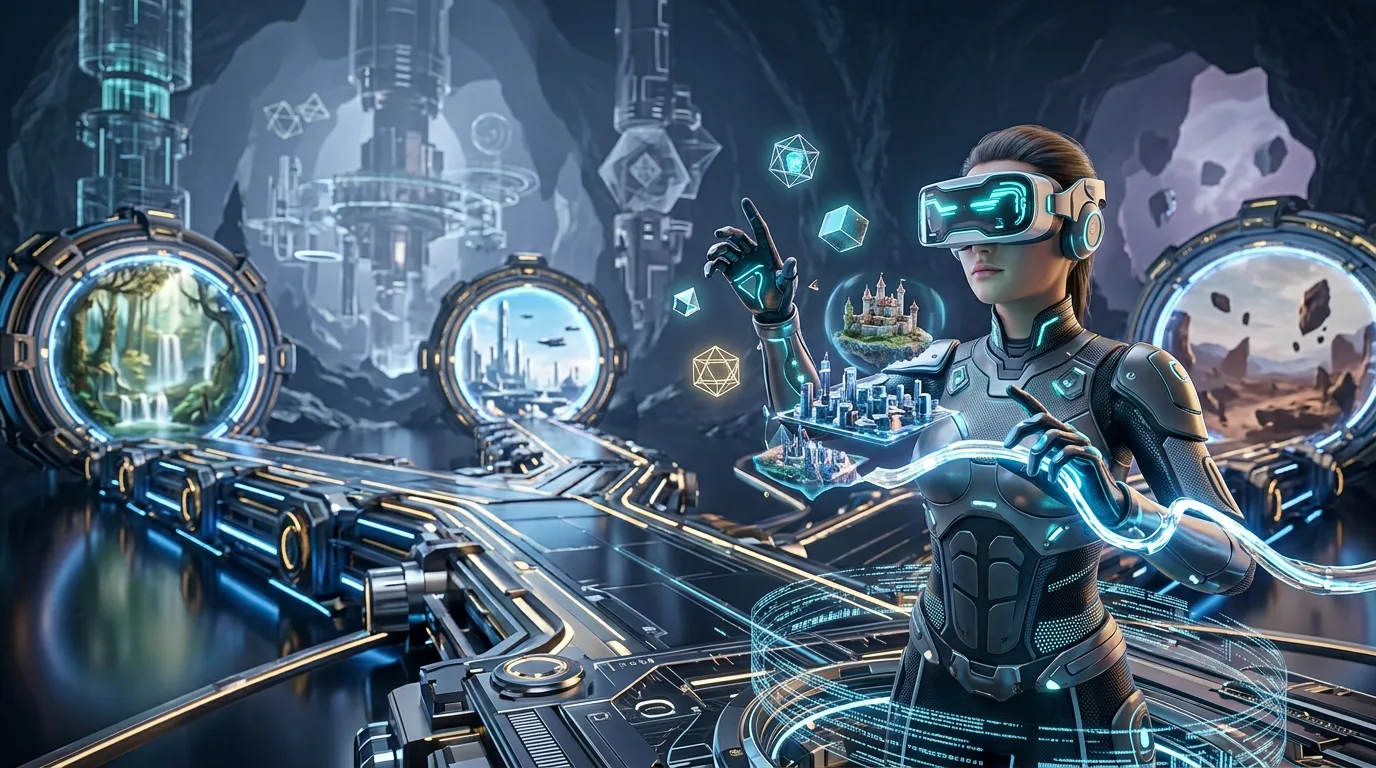
Metaverse gaming is an interactive form of digital play in which persistent 3D spaces connect players, avatars, economies, and services across devices.
What Is Metaverse Gaming?
Unlike conventional online games, these environments are designed to remain available beyond a single match or scripted session. Players may explore shared worlds, communicate through spatial voice, complete quests, trade virtual goods, attend events, or create content that other users can access. The experience can resemble a game, social network, marketplace, and creative platform at the same time.
How Metaverse Gaming Works
The underlying technology typically combines real-time networking, game engines, cloud infrastructure, identity systems, and user-generated content. Virtual reality and augmented reality can increase immersion, while browser-based access lowers hardware barriers. Standards such as the WebXR Device API help applications communicate with compatible headsets and motion controllers.
Some platforms also use blockchain networks to record ownership, enable token-based economies, or support portable digital assets. Developers building these systems may consult the Ethereum developer documentation for smart-contract architecture, though blockchain is not essential to every virtual world. For broader context, this metaverse overview traces the concept’s cultural and technical development.
In practice, the defining feature is continuity: identity, social relationships, and activities can persist as users move between interconnected digital spaces.
How Metaverse Gaming Technologies Work
Core Architecture Behind metaverse gaming
Metaverse gaming combines real-time simulation, networked identity, spatial interfaces, and persistent backend services. A typical client renders a shared 3D environment with a game engine, while authoritative servers validate movement, combat, inventory, and social events. Low-latency transport, often using WebSockets or UDP-based protocols, synchronizes state without sending every frame. For immersive headsets, the WebXR Device API exposes tracked poses, controllers, and display capabilities through browser-compatible interfaces. Prediction and interpolation conceal network delay, while server reconciliation limits cheating.
Blockchain-Based Ownership
Ownership and programmable economies add another layer. Smart contracts deployed on networks such as Ethereum record assets, permissions, and transactions; developers can consult the Ethereum developer documentation for wallet integration, contract calls, and event handling. However, blockchains rarely store gameplay state directly. Instead, games keep fast-changing data off-chain and anchor ownership or settlement proofs on-chain. This hybrid model improves responsiveness but introduces gas fees, key-management risks, and compliance concerns.
Interoperability and Persistence
At the ecosystem level, interoperability depends on shared identity standards, asset schemas, APIs, and moderation policies rather than graphics alone. Avatars may persist across worlds, but portability requires compatible skeletons, materials, licenses, and trust systems. Streaming, edge computing, and content delivery networks reduce loading times for large scenes. The broader metaverse overview provides useful context, although commercial platforms differ substantially in architecture. In practice, users experience a continuous world only when these layers coordinate reliably.
Immersion, Avatars, and Social Interaction
Metaverse gaming and embodied presence
Immersion begins with computing: instead of watching a screen, players occupy three-dimensional environments through head-mounted displays, haptic feedback, and audio. The WebXR Device API provides standards for tracking head pose and rendering scenes, while latency and field of view determine how convincing presence feels. In metaverse gaming, locomotion design matters: teleportation reduces motion sickness, whereas movement can increase spatial realism. These variables are measured continuously because timing errors can break the illusion of physical co-presence.
Avatars as technical interfaces
Avatars translate player intent into signals: posture, gaze, gestures, voice direction, and animation timing communicate state faster than chat. In worlds, identity can be customized through meshes, wearables, and assets. The Ethereum developer documentation explains wallet and smart-contract infrastructure to establish ownership or transfer items. Yet usability depends on interoperability: an avatar is valuable when its appearance and permissions survive across platforms.
Social presence and governance
Multiplayer interaction is shaped by proximity, voice spatialization, shared physics, and synchronized events. Players may collaborate, compete, or observe performances, creating emergent communities rather than scripted audiences. The metaverse overview offers context for the concept, but experiences vary by platform architecture and moderation policy. Effective systems combine reporting tools, identity controls, and server authority to limit harassment, fraud, and coordinated disruption. In practice, the experience feels most compelling when immersion supports social agency instead of distracting from it.
Digital Ownership and Metaverse Gaming Economies
In metaverse gaming, digital ownership is implemented through persistent records rather than game-specific save files. Blockchain networks can associate items such as avatars, land parcels, skins, and access passes with a user-controlled wallet. This model enables portability, provable scarcity, and secondary-market trading, although ownership does not automatically guarantee compatibility across platforms.
How metaverse gaming Economies Function
Virtual economies combine tokenized assets, creator royalties, and programmable transactions. Smart contracts can define issuance limits, transfer rules, and revenue splits, while marketplaces provide price discovery. Developers building these systems can consult the Ethereum developer documentation to understand wallets, tokens, and contract architecture. However, volatile asset prices, transaction fees, fraud, and regulatory uncertainty create substantial economic risk.
Interoperability also depends on technical standards. Browser-based immersive applications may use the WebXR Device API for access to compatible headsets and controllers, but rendering an asset is different from recognizing its ownership or behavior. Each platform must agree on metadata, permissions, and identity systems.
The broader metaverse overview illustrates why these economies extend beyond individual games: social spaces, marketplaces, and virtual services increasingly overlap. For players, the result can be meaningful participation and creator income, balanced against custodial, technical, and financial risks.
Hardware, Network Performance, and Accessibility
Hardware and metaverse gaming performance
Modern immersive play is constrained less by polygon count than by the complete hardware stack. A standalone headset must deliver low-persistence displays, six-degree-of-freedom tracking, spatial audio, and sustained thermal performance without excessive weight. Its performance envelope directly shapes comfort, presence, and session length across platforms. PCs and consoles provide higher rendering budgets, while mobile devices trade visual fidelity for portability. The WebXR Device API defines browser interfaces for head- and hand-tracked immersive experiences, helping developers target multiple form factors.
Network performance determines whether an experience feels embodied or delayed. Motion-to-photon latency should remain low, and multiplayer state synchronization requires stable jitter, not merely high bandwidth. Wi-Fi 6/6E, wired Ethernet, edge servers, and predictive netcode can reduce perceived delay; congestion, packet loss, or server distance can still cause rubber-banding and uncomfortable vestibular mismatch. Asset streaming and local caching also influence loading times.
Accessibility and platform interoperability
Accessibility is equally technical. Adjustable text scale, subtitles, remappable controls, seated modes, locomotion alternatives, and haptic or visual substitutions broaden participation. Account recovery, parental controls, and transparent wallet permissions matter when virtual goods use blockchain infrastructure; the Ethereum developer documentation explains relevant development patterns. Readers seeking a concise metaverse overview should distinguish persistent platforms from ordinary online games. Ultimately, metaverse gaming quality depends on interoperable design, reliable infrastructure, and hardware that accommodates diverse bodies, budgets, and sensory needs.
Security, Privacy, and Platform Risks
Threats in metaverse gaming
Immersive platforms combine real-time voice, biometric, location, and behavioral data with persistent identities. A compromised account can expose chat histories, digital assets, or linked wallets, while malicious code may exploit browser, headset, or identity-provider weaknesses. Verify permissions before installing worlds, enable multifactor authentication, and treat unsolicited links as phishing attempts. For browser-based experiences, review the WebXR Device API security model and keep device firmware current.
Asset ownership and smart-contract exposure
Blockchain integration does not automatically make virtual property safe or legally enforceable. Smart contracts can contain logic flaws, marketplace scams can imitate legitimate collections, and lost private keys may be unrecoverable. Before connecting a wallet, inspect contract addresses, transaction permissions, audit history, and revocation options. The Ethereum developer documentation provides technical guidance, but users remain responsible for operational security.
Privacy, moderation, and platform dependency
Social worlds can collect motion patterns, facial signals, contacts, and inferred interests, creating sensitive profiles beyond conventional game telemetry. Read retention policies, disable unnecessary sensors, and separate gaming identities from primary accounts where practical. Also consider moderation failures, sudden policy changes, server shutdowns, and vendor lock-in: purchased items or social graphs may become inaccessible. This broader metaverse overview helps contextualize why metaverse gaming requires both cybersecurity discipline and scrutiny of platform governance.
How to Evaluate a Metaverse Gaming Platform
Choosing a platform requires more than judging graphics or player numbers. Evaluate its technical architecture, ownership model, security controls, and long-term viability. A useful metaverse overview can clarify how persistent worlds, digital identities, and interoperable assets fit together.
Technical criteria for metaverse gaming
First, test device compatibility, latency, server stability, and account portability. Platforms supporting the WebXR Device API can deliver browser-based virtual and augmented reality, but implementation quality varies. Confirm whether the client supports your headset, controller, operating system, and accessibility requirements. Examine the privacy policy, authentication process, moderation tools, and whether personal data is stored centrally or on-chain.
Economics, ownership, and governance
Review transaction fees, marketplace liquidity, token volatility, and the rules governing virtual property. Smart-contract functionality should be auditable; developers should provide clear documentation, ideally comparable to the Ethereum developer documentation. Avoid platforms that promise guaranteed returns or make ownership claims without explaining custody, licensing, and transfer restrictions.
- Measure real player activity rather than registered accounts.
- Check update frequency, developer transparency, and dispute resolution.
- Verify that purchased assets remain usable if the service changes.
Ultimately, strong metaverse gaming platforms balance immersive design with reliable infrastructure, transparent economics, and meaningful user control. Select the ecosystem that performs consistently today while offering credible plans for interoperability and sustainable growth.
Frequently Asked Questions
What is it like to play games in the metaverse?
Gaming in the metaverse feels more immersive because you interact with virtual worlds through an avatar. You can explore environments, complete challenges, socialize with other players, and sometimes move between different activities within the same digital space.
Do I need special equipment to game in the metaverse?
Some metaverse games can be played on a regular computer, console, or mobile device. Others are designed for virtual reality headsets, which provide a more immersive experience but may require additional accessories and space.
Can I play with friends in the metaverse?
Yes, social interaction is a major part of many metaverse games. Players can communicate through voice or text chat, attend virtual events, work together on missions, and customize shared spaces with friends.
Can I customize my character and surroundings?
Most metaverse games offer options for personalizing your avatar, clothing, equipment, or virtual home. Depending on the platform, you may also be able to create, purchase, or trade digital items.
Are there costs involved in metaverse gaming?
Many metaverse games are free to start, but they may offer optional purchases such as cosmetic items, virtual land, or special experiences. Some platforms also require a paid headset, subscription, or access fee.
Is gaming in the metaverse safe?
The experience can be safe when you use strong account security, privacy settings, and trusted platforms. It is also important to avoid sharing personal information, be cautious with digital purchases, and report harassment or suspicious behavior.

Discussion (0)
Join the conversation